Places and People Forest of Dean
- About the Forest of Dean
- Abenhall, Gloucestershire
- Anchor Inn, Lydbrook
- Ariconium, Herefordshire
- Arthur and Edward Colliery
- Bigsweir, Gloucestershire
- Bishopswood, Herefordshireshire
- Bixslade (Bicslade)
- Blakeney, Gloucestershire
- Bloomery (definition)
- Bradley House
- Bream, Gloucestershire
- Bullo Pill, Gloucestershire
- Cannop Colliery
- Cinderford, Gloucestershire
- Clearwell, Gloucestershire
- Coleford, Gloucestershire
- Collieries
- Crawshay, Henry
- Danby Lodge
- Darkhill Brick, Colliery + Ironworks
- Dates in the Forest of Dean
- Dean Forest (Mines) Act 1838
- Dean Forest Railway
- Dean Forest (Reafforestation)
Act 1668 - The Dean Forest Riots
- Dean Hall, Littledean
- Dean Heritage Centre
- Dean Road
- Drybrook, Gloucestershire
- Eastern United Colliery
- Fairplay Iron Mine
- Findall Iron Mine
- Flaxley, Gloucestershire
- Forest of Dean Central Railway
- Free Miners
- Green Bottom
- Gunns Mill
- The Haie (house + tunnel)
- Harvey, F. W.
- Hopewell Engine Colliery
- Horlick, James and William
- Kings Lodge
- Lightmoor Colliery
- Littledean, Gloucestershire
- Lower Redbrook, Gloucestershire
- Lydbrook, Gloucestershire
- Lydney, Gloucestershire
- Mining and Forest Terms
- Mitcheldean, Gloucestershire
- Mushet, David and Robert
- Nelson Colliery
- Newland, Gloucestershire
- Newnham, Gloucestershire
- Northern United Colliery
- Offas Dyke
- Parkend, Gloucestershire
- Pillowell, Gloucestershire
- Protheroe, Edward
- Pubs of the Forest of Dean
- Purton, Gloucestershire
- Redbrook, Gloucestershire
- Ruardean, Gloucestershire
- Severn and Wye Railway Co.
- Severn Bridge Railway
- Shakemantle Iron Mine
- Speech House
- Speech House Hill Colliery
- St Briavels Castle
- St Briavels, May-pole
- Strip-and at-it Colliery
- Symonds Yat
- Teague, James
- Teague, Moses
- Trafalgar Colliery
- Tramroad
- True Blue Colliery
- Union Colliery
- Upper and Middle Forge
- Upper Lydbrook Station
- Upper Mill, Edge Hills
- Upper Redbrook
- Verderer (definition)
- Verderers' Court
- Welshbury Hill Fort
- Westbury Brook Iron Mine
- Whitecliff Furnace
- Whitecliff House
- Whitecliff Quarry
- Whitecroft
- Whitecross Manor
- Wigpool, Gloucestershire
- Wintour, Sir John
Redbrook, Gloucestershire
Several generations of Burgums of the "MM" family tree lived at Redbrook on the edge of the Forest of Dean.
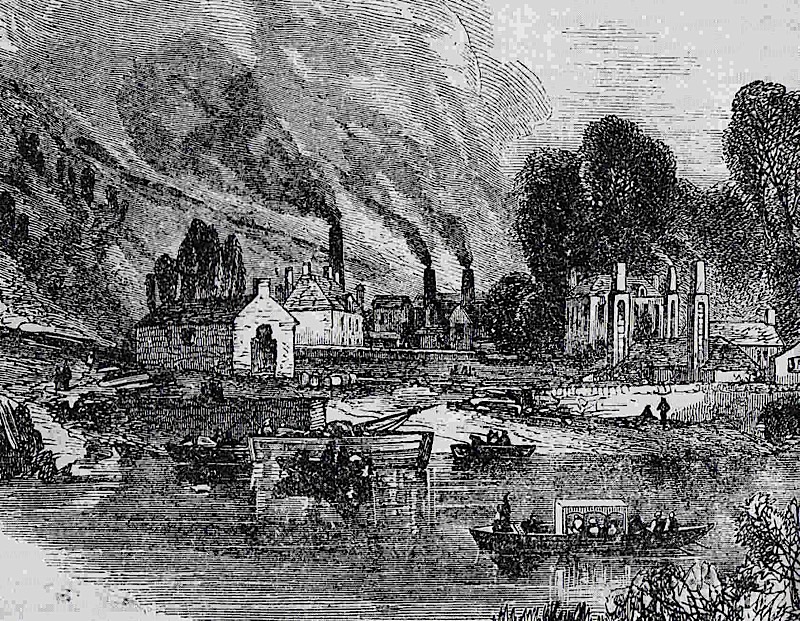 REDBROOK is set in the beautiful Wye Valley and belies its industrial past. Divided into Upper Redbrook and Lower Redbrook, it sits about 3 miles south-west of Monmouth and 2 miles north-west of Newland. Lying in the county of Monmouthshire and the parish of Dixton, it was an important centre for ironmaking and tinplating. A number of leats and dammed reservoir ponds were created from Swan Pool down to the River Wye, supplying mills, the iron furnace, the tinplate works, copper works, flour mill and brewery.
Buildings included -
Redbrooks Mills (1434-1925). There were several corn mills on the Swan Brook, which flowed fron Newland to Redbrook. These were Upper Mill (also known as Hall's Mill), Lower Mill (Bun's Mill) and King's Mill (Quick's Mill). The latter was replaced with the Wye Valley Corn Mills in the 1800's. There was at least one mill, possibly more, on the Redbrook Valley Brook, which also flowed fron Newland to Redbrook.
The Upper Redbrook Copper Works (1691-1737).
John Coster had interests in Cornwall and Bristol, but his family was originally from the Forest of Dean. He was granted a lease from Henry Benedict Hall for a period of 60 years for an annual rent of £60. There was originally a paper mill on the site named Kings Mill and it was the mill building that was converted into a Copper Works. John Coster had three sons, Thomas, John and Robert.
On his death in October 1718, it was the eldest son Thomas Coster who controlled the works at Redbrook. He ran the Copper Works with much success, sourcing the copper from his own copper mines in Cornwall. However, in about 1730, he assigned the works to the Brass Work Company of Bristol. He moved to Bristol and became MP for Bristol in 1734. During this time the works were plundered by Thomas and his Brass Work Company, leaving it a ruin. Viscount Gage took legal action against Thomas Coster in 1737. Coster died two years later, but the legal action against the Brass Work Company continued for another five years thereafter. The land and some of the buildings were later used for the tinplate works.
The Lower Redbrook Copper Works (1691-1737).
The Lower Works was begun by the Company of of Copper Miners in England in about 1691, plus or minus a year or two. We know that 50 tons of copper ore was shipped from St Ives in 1690 and 1691, rising to over 500 tons in 1692. Ivor Waters, in his About Chespstow published in 1952 says that by 1697 an amazing 986 tons was delivered from Plymouth, Devon, and Fowley, in Cornwall. Between 1716 and 1748 the Works were owned by the Chambers family, running 16 furnaces! At some time in the mid- 1700's the works were converted for the use of tinplate.
The Redbrook Tinplate Factory (1771-1962). According to E.H. Brooke in his Chronology of the Tinplate Works of Great Britain (1944) Townsend & Wood leased the Lower Copper Works site from the Company of Copper Miners in England in 1771 and commenced tinplating in 1774, producing high quality tinplate. The process involved sheet iron, then later sheet steel, covered in a very thin layer of tin. Thus the transportation of copper from Cornwall was replaced with the transportation of tin from the same county. Initially the process used charcoal for fuel, but by the early 1800's coke was used instead. The works at Redbrook were at two sites at Upper and Lower Redbrook, where the two Copper Works had once been, althought the Lower Works were significantly larger.
By now the Upper Redbrook site was in the ownership of Lord Gage who leased it to David and William Tanner in 1790. The Lower Redbrook Tinworks was under the management of Cowley and Hathaway, partners with David and William Tanner.
The Tanners were soon in difficulty and David Tanner was declared bankrupt in 1798 and the Works were taken over bt John James and William Cowley. By now the Upper Tinplate Works were idle and were eventually demolished. John James acquired the Lydney Tinplate Works in 1814 and worked both sites but gradually, over time, he began favouring the Lydney site to the neglect of Redbrook. Then, in 1828, Messers Whitehouse took a 27 year lease in the Lower Redbrook Tinworks and immediately initiated repairs, which included improving the existing water supply to the works, while also building a stone culvert from Upper Redbrook to further improve the water supply.
The Lower Redbrook Tinworks were acquired by Philip Jones in 1842, but the business must have struggled because, by 1855, the site had been badly neglected and the lawyers got involved. The works were eventually repaired and re-opened. David Griffiths was the manager in 1858 and in 1876 the side was owned by The Redbrook In Plate Company. The Works were expanded in between 1876 and 1878 after the Wye Valley Railway was built. The works closed and were re-opened several times during the late Victorian period, but rose like a Phoenix several times. It continued producing high quality very thin sheet steel, exporting its' goods all around the world, until it finally closed in December 1961.
The manager's residence, (c1700), [which still survives].
Redbrook Quay, which still exists, shipped goods down the Wye to Chespstow. Boat-building also took place at Redbrook, notably 'The Aliza', built in 1806 by Thomas Hudson.
Other industrial clues still exist including the stone warehouse and the tram-road. The Wye Valley Railway (1876-1964) crossed the Wye at Redbrook and the bridge still remains. The Boat Inn, lies on the opposite side of the river at this point. There was a railway station, a church dedicated to Our Saviour, a school and a Weslian Chapel.
The Iron Industry at Redbrook
Between the period from 1604 to 1816, two successive blast furnaces operated at Upper Redbrook. Benedict Hall was still operating the lower furnace in 1693, but in 1702 he leased the business, together with the Upper and Lower forges at Lydbrook, to Richard Avenant and John Wheeler. At a cost of £90, the lease was for 15 years. This took the furnace into the Foley Partnership and was managed by its'manager, William Rea. The furnace had the capacity to produce 600 tons of pig iron every year. According to Johnston, the partnership continued its' operations until 1725.
Eventually the furnace came to the end of its' working life and the Gage family constructed another furnace in the same area. Lord Gage leased the furnace, together with the previously mentioned two forges at Lydbrook, to Rowland Pytt. The lease was for 21 years at a rent of £200 per year. In 1756 Rowland Pytt died senior died and the lease was taken over by his son, Rowland Pytt junior. Then, in 1757, Viscount Gage mortgaged the manor of English Bicknor to John Probyn, which included the furnace (and the copper works) at Upper Redbrook. Rowland Pytt junior was well liked and a good iron maker and Lord Gage was advised to renew the lease to him in April 1761, in what were difficlt market conditions. Rowland Pytt junior died in August 1761 before the lease was completed and he was buried, following a service at Newland All Saints Church.
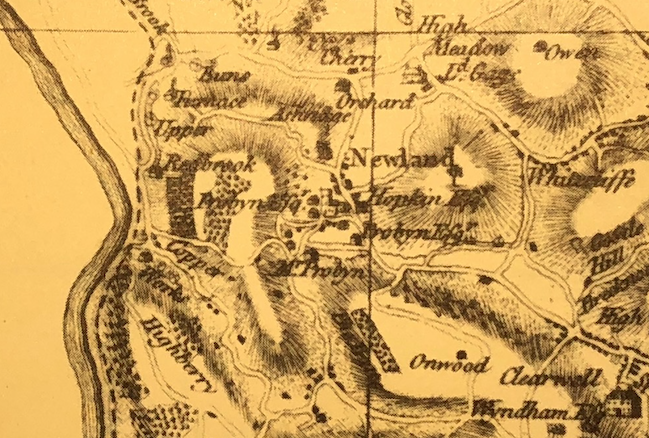 The furnace was already under going repairs at this time and, in July 1763, Lord Gage passed the lease on to John Partride senior, John Partridge junior, both of Ross-on-Wye, and Richard Reynolds of Bristol. The lease was for 21 years at an annual rent of £300 and, as before, included the forges at Upper and Lower Lydbrook.
The map on the left was made by Isaac Taylor in 1777. Near the top the house of Lord Gage is marked at High Meadow. Just above the words Upper Redbrook the furnace is shown and, below that, is the Copper Works. By 1792 the Harford, Partridge & Co, of Bristol, but that lease ceased in July 1793. Gage then lease the furnace and the Lydbrook forges to David Tanner but, by 1798, he was in significant financial difficulties and the next year he was declared bankrupt. James Davis, a steward to Lord Gage, went into partnership with others and gained the lease. The furnaces and the Lydbrook forges had fallen into much disrepair, but by July 1800 the furnace was again in blast and for several years the works were busy.
The Gage blast furnace had operated, together with the nearby foundary, since the early 1700's but, in 1818, Lord Gage finally sold the freehold to the Commissioners of Woods. In July that same year, they sold them on by auction to the existing tenant, Henry Davis. The furnace itself had been shut down for two years by then, but Davis continued to run the forge and foundry complex. He was also the tenant at the nearby Tinplate Works.
Henry Davis sold the site to Thomas Burgham (1796-1883) in 1828. Thomas ran the foundry and the stampers, which crushed blast furnace scruff for the bottle-glass industry. In 1847 the company Burgham & Harris were supplying tram wheels to the great Scottish engineer and metallurgist David Mushet, who lived in nearby Coleford.
In 1864 he wrote - "The furnace was supposed, from the cinders that have been made, to be in work for 500 to 600 years or more" (prob c200 years). "It was used to melt the Forest Iron Ore, also the Lancashire Ore, with charcoal. The furnace to my knowledge worked up till the year 1816. " He continued - "I am not in the habit of using Forest ore in the Foundry Business. The pig iron I use is of different sorts and old castings." Thomas continued as an iron founder at until 1870. The foundry closed in around 1874 and the buildings later demolished. A small hamlet still exists there called 'The Foundry.'
 The Burghams at Redbrook
 Thomas Burgham married his first wife Esther Knight (1799-1833) in 1816 and had eight children at Redbrook. William, Thomas, Sarah, Esther, John, Henry, Eliza and Lydia were born between 1817 and 1831. Following Esther's death, he married Harriet Weare and they had children Edwin, James, William, George and Sarah Ann between 1836 and 1846. His son Henry (1827-1869) worked as a moulder, but then began brewing. Following his death, his wife Eliza Burgham continued the business, which was then taken over by her son Oliver Burgham (1863-1939).
Brewing at Redbrook
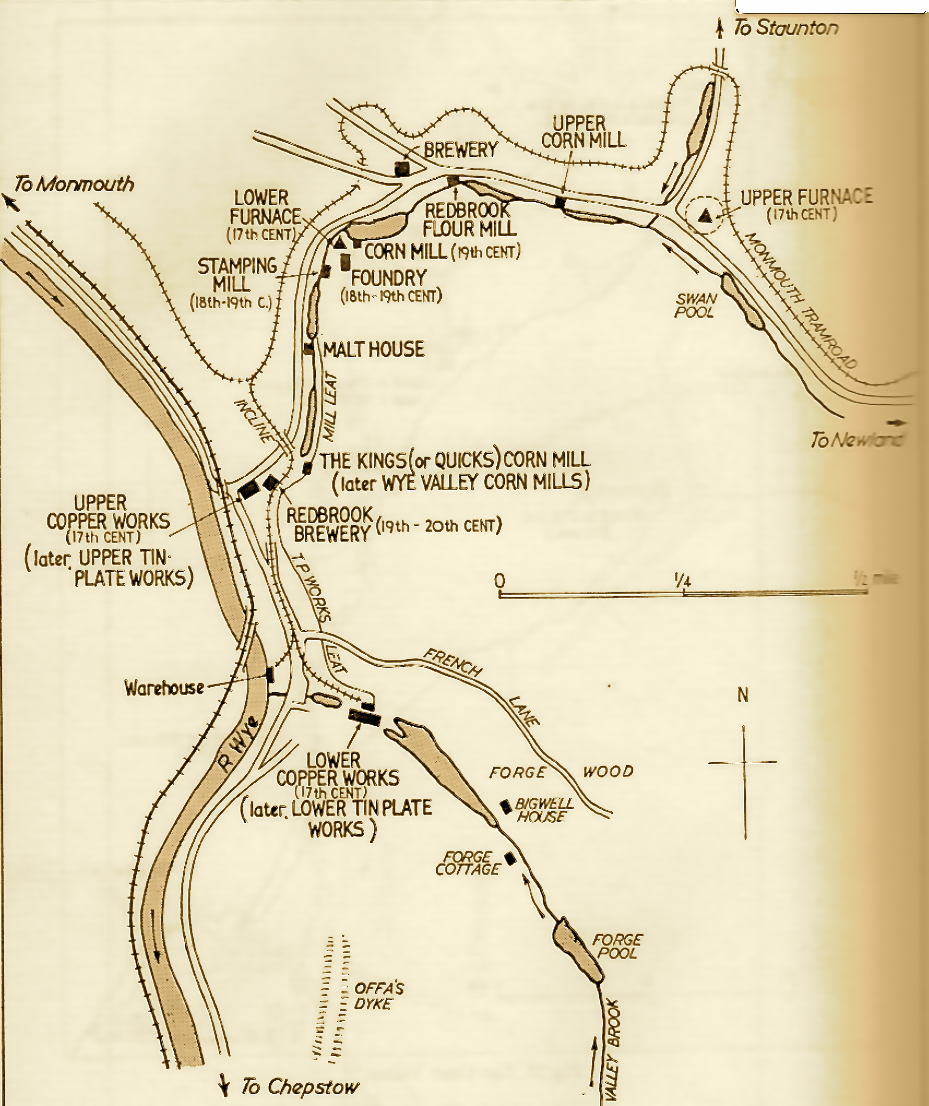
There were two breweries in Redbrook (see map right). The one owned by Oliver was sited down by the River Wye, near the Upper Tin Plate Works. It was south of the incline between the tramroad and the road. A second brewery, further north near Redbrook Flour Mill at Upper Redbrook was owned by James Hall and described as "house, offices, brewhouse, malthouse and sheds". Both were demolished after the Second World War.
Kelly’s Directory of 1870 listed the principal residents as -
Upper Redbrook
Adams John - carpenter and wheelwright
Burgham, Mrs Eliza - brewer & malster
Burgham, Thomas - iron founder
Courteen, Thomas - corn, flour, and hop merchant and malster
Davis, Mrs Mary - miller
Groves James - grocer
Moore Theophilus - miller
Payne, Henry - wheelwright and blacksmith
Lower Redbrook
Beard, James - Bell Inn
Beard, Mrs Sarah - King's Head
Hudson, John - shopkeeper and timber merchant
Redbrook Tin Plate Co. (Charles Frederick Medhurst, resident manager)
Walters, George - farmer, Highbury Farm
More on the MM Family Tree here.