Places and People Forest of Dean
- About the Forest of Dean
- Abenhall, Gloucestershire
- Anchor Inn, Lydbrook
- Ariconium, Herefordshire
- Arthur and Edward Colliery
- Bigsweir, Gloucestershire
- Bishopswood, Herefordshireshire
- Bixslade (Bicslade)
- Blakeney, Gloucestershire
- Bloomery (definition)
- Bradley House
- Bream, Gloucestershire
- Bullo Pill, Gloucestershire
- Cannop Colliery
- Cinderford, Gloucestershire
- Clearwell, Gloucestershire
- Coleford, Gloucestershire
- Collieries
- Crawshay, Henry
- Danby Lodge
- Darkhill Brick, Colliery + Ironworks
- Dates in the Forest of Dean
- Dean Forest (Mines) Act 1838
- Dean Forest Railway
- Dean Forest (Reafforestation)
Act 1668 - The Dean Forest Riots
- Dean Hall, Littledean
- Dean Heritage Centre
- Dean Road
- Drybrook, Gloucestershire
- Eastern United Colliery
- Fairplay Iron Mine
- Findall Iron Mine
- Flaxley, Gloucestershire
- Forest of Dean Central Railway
- Free Miners
- Green Bottom
- Gunns Mill
- The Haie (house + tunnel)
- Harvey, F. W.
- Hopewell Engine Colliery
- Horlick, James and William
- Kings Lodge
- Lightmoor Colliery
- Littledean, Gloucestershire
- Lower Redbrook, Gloucestershire
- Lydbrook, Gloucestershire
- Lydney, Gloucestershire
- Mining and Forest Terms
- Mitcheldean, Gloucestershire
- Mushet, David and Robert
- Nelson Colliery
- Newland, Gloucestershire
- Newnham, Gloucestershire
- Northern United Colliery
- Offas Dyke
- Parkend, Gloucestershire
- Pillowell, Gloucestershire
- Protheroe, Edward
- Pubs of the Forest of Dean
- Purton, Gloucestershire
- Redbrook, Gloucestershire
- Ruardean, Gloucestershire
- Severn and Wye Railway Co.
- Severn Bridge Railway
- Shakemantle Iron Mine
- Speech House
- Speech House Hill Colliery
- St Briavels Castle
- St Briavels, May-pole
- Strip-and at-it Colliery
- Symonds Yat
- Teague, James
- Teague, Moses
- Trafalgar Colliery
- Tramroad
- True Blue Colliery
- Union Colliery
- Upper and Middle Forge
- Upper Lydbrook Station
- Upper Mill, Edge Hills
- Upper Redbrook
- Verderer (definition)
- Verderers' Court
- Welshbury Hill Fort
- Westbury Brook Iron Mine
- Whitecliff Furnace
- Whitecliff House
- Whitecliff Quarry
- Whitecroft
- Whitecross Manor
- Wigpool, Gloucestershire
- Wintour, Sir John
Ariconium
|
Ariconium was a small Roman town, road station and place of iron working in Roman Britain. It was located at Bury Hill, between Weston under Penyard and Bromash not far from Ross on Wye. Evidence indicates the site existed before the Roman era and then came under Roman influence. It has yet to be fully excavated, but there is lots of evidence of iron-woking, smelting anf forges, together with the foundations of several large buildings and some tessellated pavements. It was founded in about 50 AD and consisted of a military fort, a settlement and an industrial complex. The site was abandoned round about 360 AD but little is known about the circumstances, however there was some evidence of burning. There was a general breakdown in authority at that time and violence and plundering probably resulting in the abandonment of the site. Excavations indicated the existence of bloom furnaces, forges, and iron workings.
Nearby Forest of Dean was an ancient source of iron ore and charcoal and there is evidence of early mining and smelting, with many sites consisting of groups of forges. The site of Ariconium was on the rise of a hill, as that the terrain increased the airflow passing over it. The bloomeries here were using a process that produced imperfect iron, together with dirt and cinders. The Romans contributed the use of bellows, creating an air blast that was much hotter. This produced better iron, albeit inferior to the techniques used in later centuries. Huge amounts of charcoal would have been necessary and the result was that large amounts of cinder refuse or scoriae was dumped in great piles at such sites. So this was a large iron-working site left behind massive refuse piles covering 100 acres, although some suggest it might be more than double this size. Pottery remnants were found here and numerous artifacts, including pre-Roman British and Roman coins.
The Anglo-Saxon Chronicle stated that the Romans, in 418 AD, collected all the treasures of "gold" (valuables) which they had in Britain, and part of the gold they had concealed in the ground that no man might afterwards find them. And part they carried into Gaul. Gold, of course, was a figurative term for any weath rather than actual gold. Basically the Romans buried what they could not carry!
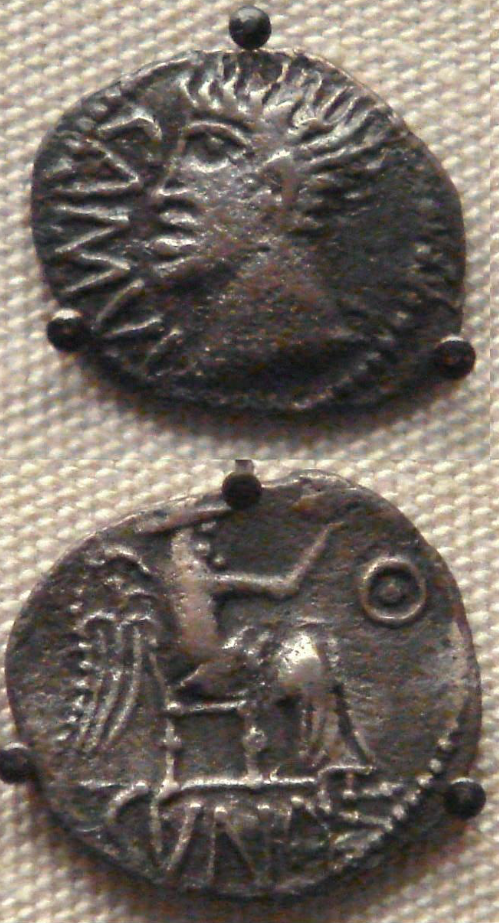
Picture (right) - Several pre-Roman British coins were discovered at Ariconium, including one minted by Cunobelin. This is an example of a Cunobelin coin, not the actual one found. |
 Before a chance discovery in 1758, little was known about Ariconium or its’ location. However several excavations over the last two centuries has revealed some of the story. The site is approximately rectangular and contained streets with domestic dwellings, industrial premises such as iron workings, shops and burial sites.