Places and People Forest of Dean
- About the Forest of Dean
- Abenhall, Gloucestershire
- Anchor Inn, Lydbrook
- Ariconium, Herefordshire
- Arthur and Edward Colliery
- Bigsweir, Gloucestershire
- Bishopswood, Herefordshireshire
- Bixslade (Bicslade)
- Blakeney, Gloucestershire
- Bloomery (definition)
- Bradley House
- Bream, Gloucestershire
- Bullo Pill, Gloucestershire
- Cannop Colliery
- Cinderford, Gloucestershire
- Clearwell, Gloucestershire
- Coleford, Gloucestershire
- Collieries
- Crawshay, Henry
- Danby Lodge
- Darkhill Brick, Colliery + Ironworks
- Dates in the Forest of Dean
- Dean Forest (Mines) Act 1838
- Dean Forest Railway
- Dean Forest (Reafforestation)
Act 1668 - The Dean Forest Riots
- Dean Hall, Littledean
- Dean Heritage Centre
- Dean Road
- Drybrook, Gloucestershire
- Eastern United Colliery
- Fairplay Iron Mine
- Findall Iron Mine
- Flaxley, Gloucestershire
- Forest of Dean Central Railway
- Free Miners
- Green Bottom
- Gunns Mill
- The Haie (house + tunnel)
- Harvey, F. W.
- Hopewell Engine Colliery
- Horlick, James and William
- Kings Lodge
- Lightmoor Colliery
- Littledean, Gloucestershire
- Lower Redbrook, Gloucestershire
- Lydbrook, Gloucestershire
- Lydney, Gloucestershire
- Mining and Forest Terms
- Mitcheldean, Gloucestershire
- Mushet, David and Robert
- Nelson Colliery
- Newland, Gloucestershire
- Newnham, Gloucestershire
- Northern United Colliery
- Offas Dyke
- Parkend, Gloucestershire
- Pillowell, Gloucestershire
- Protheroe, Edward
- Pubs of the Forest of Dean
- Purton, Gloucestershire
- Redbrook, Gloucestershire
- Ruardean, Gloucestershire
- Severn and Wye Railway Co.
- Severn Bridge Railway
- Shakemantle Iron Mine
- Speech House
- Speech House Hill Colliery
- St Briavels Castle
- St Briavels, May-pole
- Strip-and at-it Colliery
- Symonds Yat
- Teague, James
- Teague, Moses
- Trafalgar Colliery
- Tramroad
- True Blue Colliery
- Union Colliery
- Upper and Middle Forge
- Upper Lydbrook Station
- Upper Mill, Edge Hills
- Upper Redbrook
- Verderer (definition)
- Verderers' Court
- Welshbury Hill Fort
- Westbury Brook Iron Mine
- Whitecliff Furnace
- Whitecliff House
- Whitecliff Quarry
- Whitecroft
- Whitecross Manor
- Wigpool, Gloucestershire
- Wintour, Sir John
Newnham, Gloucestershire
Newnham is a village in the Forest of Dean just south-west of Littledean. It lies on the River Severn on the A48, which goes between Gloucester and Chepstow. The village was a chapelry of Westbury and had a chapel of ease from about 1018, the population being modest in size. A parish church was built in the 1300's but it was threatened by the ever changing River Severn, and a new church Newnham St Peter was built. (Click on "St Peter" in blue to read more and click BACK to return here). The church was famously damaged by a gunpower explosion in 1644 during the English Civil War. Newnham was important because it was on the River Severn and it was possible to ford the river here. The Romans had three roads cross here, the Saxons made a settlement here and the Normans built a motte-and-Bailey fort her to defend the shore line. Later the ford became inpassable after the river washed the sands and stone away. In also grew and became an important port in medieval times. |
|
A story, difficult to verify, was that Henry II launched 400 ships, with 5,000 men form this port, for the invasion of Ireland, but that seems a very large fleet for a port on a difficult tidal river. Still, we do know Newnham thrived as a port, but its advantage was lost by the construction of the Gloucester and Sharpness canel. Newnham had a railway station from 1851, but it closed in 1964. As well as being an important port, trading in timber, bark from oak trees for tanning and, of course, coal. It was a site for ship building, had its' modest own tanning industry and some glass-making. The exports went to London, Bristol and to ireland, but not exclusively. | 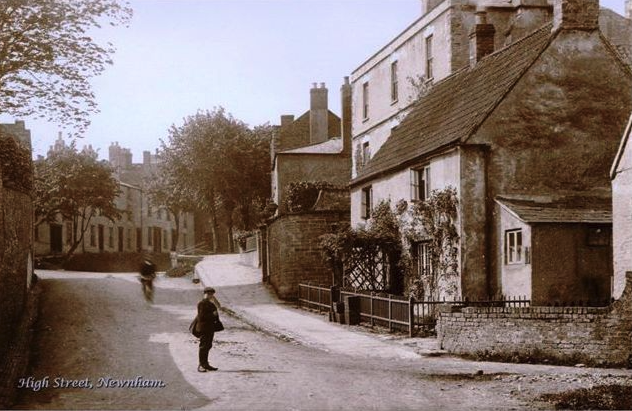
|
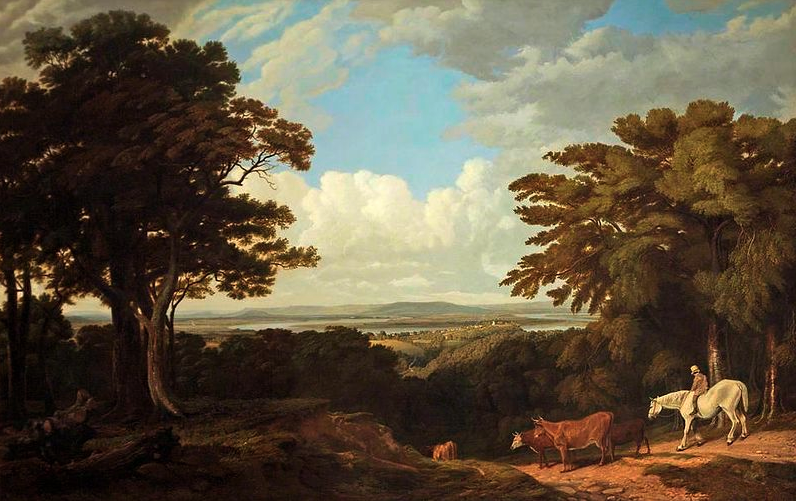
The picture below is entitled Newhnam-on-Severn from Dean Hill and was painted by William Turner, of Oxford (1789-1862) .