Places and People Forest of Dean
- About the Forest of Dean
- Abenhall, Gloucestershire
- Anchor Inn, Lydbrook
- Ariconium, Herefordshire
- Arthur and Edward Colliery
- Bigsweir, Gloucestershire
- Bishopswood, Herefordshireshire
- Bixslade (Bicslade)
- Blakeney, Gloucestershire
- Bloomery (definition)
- Bradley House
- Bream, Gloucestershire
- Bullo Pill, Gloucestershire
- Cannop Colliery
- Cinderford, Gloucestershire
- Clearwell, Gloucestershire
- Coleford, Gloucestershire
- Collieries
- Crawshay, Henry
- Danby Lodge
- Darkhill Brick, Colliery + Ironworks
- Dates in the Forest of Dean
- Dean Forest (Mines) Act 1838
- Dean Forest Railway
- Dean Forest (Reafforestation)
Act 1668 - The Dean Forest Riots
- Dean Hall, Littledean
- Dean Heritage Centre
- Dean Road
- Drybrook, Gloucestershire
- Eastern United Colliery
- Fairplay Iron Mine
- Findall Iron Mine
- Flaxley, Gloucestershire
- Forest of Dean Central Railway
- Free Miners
- Green Bottom
- Gunns Mill
- The Haie (house + tunnel)
- Harvey, F. W.
- Hopewell Engine Colliery
- Horlick, James and William
- Kings Lodge
- Lightmoor Colliery
- Littledean, Gloucestershire
- Lower Redbrook, Gloucestershire
- Lydbrook, Gloucestershire
- Lydney, Gloucestershire
- Mining and Forest Terms
- Mitcheldean, Gloucestershire
- Mushet, David and Robert
- Nelson Colliery
- Newland, Gloucestershire
- Newnham, Gloucestershire
- Northern United Colliery
- Offas Dyke
- Parkend, Gloucestershire
- Pillowell, Gloucestershire
- Protheroe, Edward
- Pubs of the Forest of Dean
- Purton, Gloucestershire
- Redbrook, Gloucestershire
- Ruardean, Gloucestershire
- Severn and Wye Railway Co.
- Severn Bridge Railway
- Shakemantle Iron Mine
- Speech House
- Speech House Hill Colliery
- St Briavels Castle
- St Briavels, May-pole
- Strip-and at-it Colliery
- Symonds Yat
- Teague, James
- Teague, Moses
- Trafalgar Colliery
- Tramroad
- True Blue Colliery
- Union Colliery
- Upper and Middle Forge
- Upper Lydbrook Station
- Upper Mill, Edge Hills
- Upper Redbrook
- Verderer (definition)
- Verderers' Court
- Welshbury Hill Fort
- Westbury Brook Iron Mine
- Whitecliff Furnace
- Whitecliff House
- Whitecliff Quarry
- Whitecroft
- Whitecross Manor
- Wigpool, Gloucestershire
- Wintour, Sir John
Lightmoor Colliery
|
Lightmoor Colliery was sited just less than two miles south-west of the centre of Cinderford. It was worked from 1832 and two shafts had been dug three years later. Then, in 1841, the gale was awarded to William Crawshay and Moses Teague. They had pumping and winding engines running by 1841 and, by 1854 they had four shafts dug. They further expanded the gale deeping the shafts to 936 feet and began acquiring other nearby gales.
This transformed Lightmoor into one of the largest collieries in Dean. In 1856 it produced 86,508 tons of coal. In 1899 it was employing 594 people underground with another 110 support workers above ground. By 1906 Lightmoor was producing between 800 and 900 tons every day!
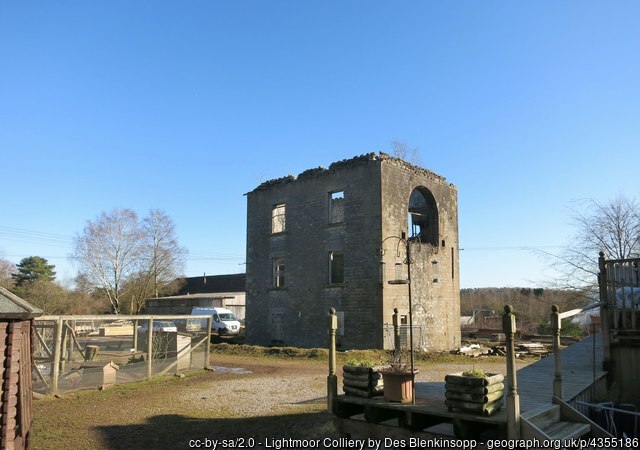
The colliery worked the Supra-Pennant Group Upper Coal Measures. These included the seams of Twenty Inch, Lowery, Starkey, Rocky and Churchway High Delf. They mainly produced household coal. An early tramroad connected Lightmoor with the Forest of Dean tramroad at Rusbridge to the east. In 1854 a private line joined to the Forest of Dean Branch near Cinderford. Latterly there were problems with flooding, resulting in the purchase Speeech House Hill and Trafalgar Collieries. Although muted from the late 1920's and through the 1930's, the colliery soldiered on until it was closed finally closed in June 1940. The old pumping house, built of stone, still stands although it has no roof. (picture above) , It is the last one standing in the Forest of Dean! The pre-1830's beam engine is preserved and can be seen at the Dean Heritage Museum. |