Places and People Forest of Dean
- About the Forest of Dean
- Abenhall, Gloucestershire
- Anchor Inn, Lydbrook
- Ariconium, Herefordshire
- Arthur and Edward Colliery
- Bigsweir, Gloucestershire
- Bishopswood, Herefordshireshire
- Bixslade (Bicslade)
- Blakeney, Gloucestershire
- Bloomery (definition)
- Bradley House
- Bream, Gloucestershire
- Bullo Pill, Gloucestershire
- Cannop Colliery
- Cinderford, Gloucestershire
- Clearwell, Gloucestershire
- Coleford, Gloucestershire
- Collieries
- Crawshay, Henry
- Danby Lodge
- Darkhill Brick, Colliery + Ironworks
- Dates in the Forest of Dean
- Dean Forest (Mines) Act 1838
- Dean Forest Railway
- Dean Forest (Reafforestation)
Act 1668 - The Dean Forest Riots
- Dean Hall, Littledean
- Dean Heritage Centre
- Dean Road
- Drybrook, Gloucestershire
- Eastern United Colliery
- Fairplay Iron Mine
- Findall Iron Mine
- Flaxley, Gloucestershire
- Forest of Dean Central Railway
- Free Miners
- Green Bottom
- Gunns Mill
- The Haie (house + tunnel)
- Harvey, F. W.
- Hopewell Engine Colliery
- Horlick, James and William
- Kings Lodge
- Lightmoor Colliery
- Littledean, Gloucestershire
- Lower Redbrook, Gloucestershire
- Lydbrook, Gloucestershire
- Lydney, Gloucestershire
- Mining and Forest Terms
- Mitcheldean, Gloucestershire
- Mushet, David and Robert
- Nelson Colliery
- Newland, Gloucestershire
- Newnham, Gloucestershire
- Northern United Colliery
- Offas Dyke
- Parkend, Gloucestershire
- Pillowell, Gloucestershire
- Protheroe, Edward
- Pubs of the Forest of Dean
- Purton, Gloucestershire
- Redbrook, Gloucestershire
- Ruardean, Gloucestershire
- Severn and Wye Railway Co.
- Severn Bridge Railway
- Shakemantle Iron Mine
- Speech House
- Speech House Hill Colliery
- St Briavels Castle
- St Briavels, May-pole
- Strip-and at-it Colliery
- Symonds Yat
- Teague, James
- Teague, Moses
- Trafalgar Colliery
- Tramroad
- True Blue Colliery
- Union Colliery
- Upper and Middle Forge
- Upper Lydbrook Station
- Upper Mill, Edge Hills
- Upper Redbrook
- Verderer (definition)
- Verderers' Court
- Welshbury Hill Fort
- Westbury Brook Iron Mine
- Whitecliff Furnace
- Whitecliff House
- Whitecliff Quarry
- Whitecroft
- Whitecross Manor
- Wigpool, Gloucestershire
- Wintour, Sir John
The Dean Forest Riots
|
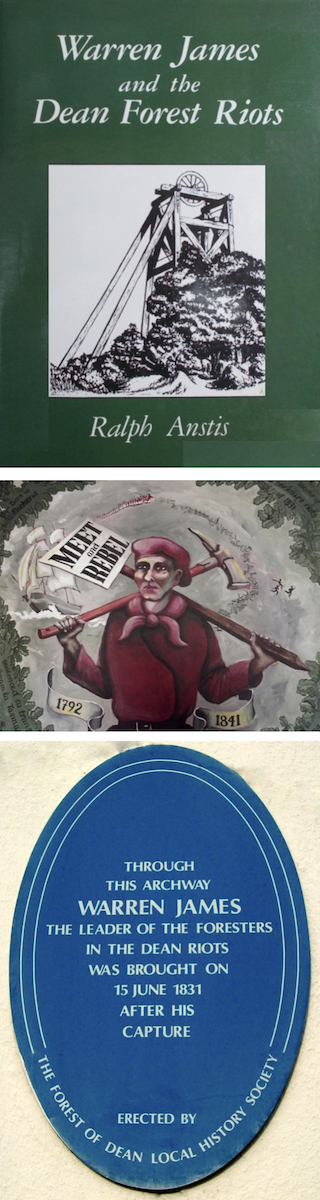
The Dean Forest Riots with big implications and high stakes! The Forest of Dean was (and is) a largely forested area where many locals (Foresters) were living and working. Its natural resources were timber (trees!), iron-ore and coal. Free-ming rights were given to to foresters by Edward I, a rewards for helping him to, literally, undermine the Scottish defences during his siege of Berwick, just across the border with England. Their mining skills, which changed the course of the battles, gave them the right to become "Free Miners". Inevitably those right were disputed over the centuries and, significantly, when the Earl of Pembroke sought to enclose large areas of the forest, the Foresters took him to the Excheequer Court and won! Case closed! Inevitably, during the Industrial Revolution, the Crown sought to allow the free market, industrialists from elsewhere to own the land exploit the mineral rights.The Crown outlawed the Mine Law Court, which dealt with Free Miners rights and rules, in 1777. They even took the legal documents of the Mine Law Court and destryed them! This opened up the Forest of Dean to exploitation from outside industrialists who began opening and running large iron and coal mining operations. It was impossible for the Freeminers to compete with this and many found themselves having to work as labourers for the industrialists. If that wasn't enough, the Government decided that there was a severe shortage of timber to build navel vessels. Parliament duly passed Dean Forest (Timber) Act in 1808 As part of the Act, the local deputy surveyor for the Forest of Dean, Edward Machen, In the following 8 years he enthusiastically enclosed and replanted 11,000 of woodland as provided for in the Act. For normal Foresters this was a disaster. They were already very poor and were now unable to foriage for timber, cut down trees or hunt. They had lost their freemining status and their historic animal grazing rights. Their poverty was getting worse and the only way was down! The Foresters sent a petition in both 1828 and 1829 requesting to have the fences removed. They were told no. The next year the "Committee of Free Miners" asked Warren James, a self-educated miner, to petition the Chief Commisioner in London and that was presented to the House of Commons on 11th June 1830. It did not succeed. One year later Warren James called for Free Miners to attend a meeting To "open up the Forest". Warren James and Edward Machen were well-known to each other, both attending the same church in Parkend. They met at a public meeting in Parkend, but agreed on nothing. So the meeting with the miners went ahead on the 8th June, a Wednesday. Over a hundred miners assembled at the Parkhill Enclosure, near Parkend, south of what is now Whitemead Park. They began to demolish the fencing. Edward Machen and 50 unarmed men were helpless to stop them. By Friday 50 soldiers had arrived from Monmouth Barracks, but now there were 2,000 Foresters! By saturday evening, unbroken fencing was hard to find. However by Sunday hundreds of soldiers arrived from Plymouth and Donaster and the Foresters retreated back to their homes. Warren James was arrested and sent to trial at Gloucester Assizes. Machin, not surprisingly was the first witness and spoke against him. James was found guilty felony by the jury under the Riot Act, but they recommended clemency due to his previous good character. The judge thought otherwise and sentenced him to death!This was later commuted to transportation. Some other were imprisoned (up to 2 years) or given fines. Approximately 100 other Foresters, under threat of punishment, agreed to "voluntarily" replace and rebuild the enclousure fencing! Transportation was harsh and dangerous, but James arrived in Van Diemen's Land (Tasmania) on 14th Febuary 1832. He found himself in a working party doing Public Works. He apparently managed to behave himself for 4 years. However he then received a punishment (one week in prison) in January 1836 for neglect of duty. A month later he received 36 lashes for "gross contempt to the commandant" and sent to work in a coal mine. Back in the Forest of Dean, Foresters asked for him to be pardoned, apparently supported by Edward Machen. This was granted in February 1836, but was not offered it until September. Also he would have to pay his own passage. James was in poor health and he had not contacted his family since his departure from England. He also would not have had the fare home. Warren James died in Hobart 5 years later, very well, living in a rented room and refusing any medical treatment. |
 |