Places and People Forest of Dean
- About the Forest of Dean
- Abenhall, Gloucestershire
- Anchor Inn, Lydbrook
- Ariconium, Herefordshire
- Arthur and Edward Colliery
- Bigsweir, Gloucestershire
- Bishopswood, Herefordshireshire
- Bixslade (Bicslade)
- Blakeney, Gloucestershire
- Bloomery (definition)
- Bradley House
- Bream, Gloucestershire
- Bullo Pill, Gloucestershire
- Cannop Colliery
- Cinderford, Gloucestershire
- Clearwell, Gloucestershire
- Coleford, Gloucestershire
- Collieries
- Crawshay, Henry
- Danby Lodge
- Darkhill Brick, Colliery + Ironworks
- Dates in the Forest of Dean
- Dean Forest (Mines) Act 1838
- Dean Forest Railway
- Dean Forest (Reafforestation)
Act 1668 - The Dean Forest Riots
- Dean Hall, Littledean
- Dean Heritage Centre
- Dean Road
- Drybrook, Gloucestershire
- Eastern United Colliery
- Fairplay Iron Mine
- Findall Iron Mine
- Flaxley, Gloucestershire
- Forest of Dean Central Railway
- Free Miners
- Green Bottom
- Gunns Mill
- The Haie (house + tunnel)
- Harvey, F. W.
- Hopewell Engine Colliery
- Horlick, James and William
- Kings Lodge
- Lightmoor Colliery
- Littledean, Gloucestershire
- Lower Redbrook, Gloucestershire
- Lydbrook, Gloucestershire
- Lydney, Gloucestershire
- Mining and Forest Terms
- Mitcheldean, Gloucestershire
- Mushet, David and Robert
- Nelson Colliery
- Newland, Gloucestershire
- Newnham, Gloucestershire
- Northern United Colliery
- Offas Dyke
- Parkend, Gloucestershire
- Pillowell, Gloucestershire
- Protheroe, Edward
- Pubs of the Forest of Dean
- Purton, Gloucestershire
- Redbrook, Gloucestershire
- Ruardean, Gloucestershire
- Severn and Wye Railway Co.
- Severn Bridge Railway
- Shakemantle Iron Mine
- Speech House
- Speech House Hill Colliery
- St Briavels Castle
- St Briavels, May-pole
- Strip-and at-it Colliery
- Symonds Yat
- Teague, James
- Teague, Moses
- Trafalgar Colliery
- Tramroad
- True Blue Colliery
- Union Colliery
- Upper and Middle Forge
- Upper Lydbrook Station
- Upper Mill, Edge Hills
- Upper Redbrook
- Verderer (definition)
- Verderers' Court
- Welshbury Hill Fort
- Westbury Brook Iron Mine
- Whitecliff Furnace
- Whitecliff House
- Whitecliff Quarry
- Whitecroft
- Whitecross Manor
- Wigpool, Gloucestershire
- Wintour, Sir John
Mining and Forest Terms
Below is a list of mining terms, which may help the reader. This is not an exclusive list and I may add terms to it if, and when, I get time. If you find a term you do not understand, feel free to Google it!
They are horizonal tunnels (or near horizontal tunnels) that give access to seams of coal. As well as access, they can also provide drainage and ventilation. They are sometimes called drifts (see below). However, an adit usually leads to and from the surface, whereas a drift can be any near-horizontal underground passage that follows a coal seam or joins seams of coal together.
The customary laws and privileges of the Forest of Dean Mine Law Courts were said to have been written originally in a document called the "Book of Dennis". However, more recent research has find a copy or further references to the document. Some question whether it existed at all!
Delves are circular depressions found in the ground, originally shallow surface coal mines, dating from Roman times and possibly earlier.
This was the Mining Agent & Crown Receiver appointed by the Crown to collect the mine taxes and royalties. He also supervised the running of the Forest of Dean coal and iron mines in accordance the various Dean Forest Mines Acts and any subsequent further legislation.
This was a mine where the entrance was worked through an entrance tunnel - a "walk in".
The name given to a statutory defined area of a vein or veins of coal or iron ore that the mine could work and is granted only to a free miner by the Crown. Gale Boundary Stones:-The gales are marked by gale boundary stones permanently set in the surface of the soil. Defined by Act of parliament in the Dean Forest Mines Acts.
He was the owner of a gale or gales. A Galee was only permitted to own three gales.
He was a person of high standing who owned and controlled an empire built on the extraction of the iron ore from his mines. He often also owned the iron furnaces that were used to smelt the iron ore. Examples include Henry & Edwin Crawshay, Aaron Goold, Moses Teague & Edward Protheroe.
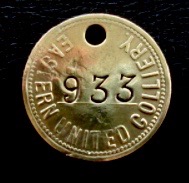 This was a process where a brass token would have the miners electric lamp number stamped on it, together with the colliery name. Each miner would be issued with one when he took his lamp from the lamp room. It would be placed on a numbered hook on a wooden board before descent into the mine and remain there whilst the miner was underground. When leaving the mine the miner take his "check" back. This provided a constant check on who was underground at one anytime.This was of extreme importance during any accident or mishap so they knew exactly who was underground.
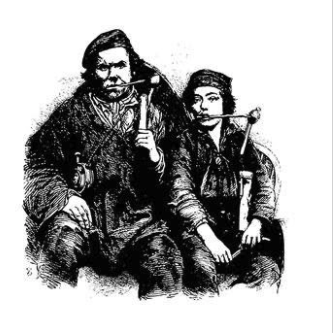 This was originally a ball of clay into which an iron miner would insert a candle.
A forked wooden stick was positioned through the side of the clay so that the candle did not remain in front of the miners eyes.
A second wooden stick supported the clay and candle on the miner's chest.
This was a man whose job was to look after the horses Underground and keep a check on their welfare. This was a liitle different from Timothy Burgum of Littledean (RR family tree) who worked, for a while, as a blacksmith underground primarily shoeing horses and ponies. He gave that up to emigrate to Australia.
Pill is an Anglo-Saxon term meaning a creek or inlet off a river, channel or small harbour. They are often tidal and are sometime associated with a dock. The word also exists in the Welsh language.
This was a small horse who was placed underground and was used to haul iro ore or coal carts, empty or full, to and from the workings underground. They were mostly kept underground in stables. Occasionally they might be brought up ouside during holidays periods (ther were noy many) and would graze above ground. Lightmore Colliery, for example, used larger horse underground, while Cannop Colliery brought its' horse out every day. It is shocking to report that the Arthur and Edward Colliery on closing in 1959 shot its' pit ponies!
 Scowles are circular landscape depressions found in the ground and are possibly unique to the Forest of Dean. The current thinking is that these were natural features where ancient cave systems rich in iron ore, were uplifted geologically and then eroded over millions of years. It is possible the scowles were exploited during the iron age, but certainly during the time of the Roman occupation. What we see now are the resulting surfaces workings where iron ore was extracted leaving hollows and small quarry-like shapes in the ground.
Some of the shallow hollows may be the result of infilling from the resultant spoil, while others could the result of subsidence. The Crown was receiving royalties from the iron mining of scowles in the 1200's.
Puzzlewood, near Coleford, is one of the finest examples of scowles covering 14 acres and over a mile of paths was laid in the early 1800's creating a magical tourist attraction. Many TV programs and films have used the setting including the BBC's Merlin and Dr Who, and J.J. Abrams film Star Wars: The Force Awakens. Tolkien carried out archaeological work at another site, Dwarf's Hill, in Lydney Park, during in the 1920's and that and Puzzlewood were the likely inspiration for his descriptions of Middle-earth forests in The Lord of the Rings.
Picture: Reiner Tegtmeyer [CC BY-SA 2.0], via Wikimedia Commons
Prior to trains and railways, horses would haul coal, iron ore, stone and other goods along rails for privately owned charged per ton. Eventually, of course, this method of haulage was superseded by steam railways. Many tram road routes still survive locally.
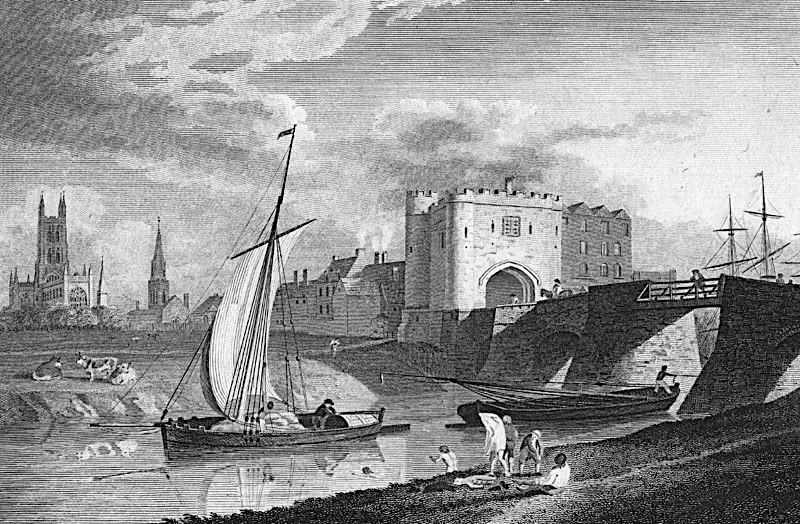
A Trow is a shllow-bottomed sailing vessel designed and built to operate in the shallow waters of the River Severn and the River Wye. They would carry cargo both upstream (sometimes as far as Worester and beyond) and downstream, some even crossing the English Channel to France with the addition of a temporary keel. The picture (left) shows two trows at Gloucester. The first has the mast up, while the second trow has the mast down as it passes under the bridge. The mast was framed at the base on three sides and locked upright normally with a pin or a rope lashing. Removal of the pin would enable the mast to be lowered towards the stern using a forestay attached to the mast's top and then raised again afterwards. Under bridges and in shallow water it would be necessary to pull the boats along from the river bank. Men could be hired locally for this purpose usually from riverside pubs! The trows together with the cargo could weigh many tons! Sadly the trows eventually gave way to the faster and more efficient railways.
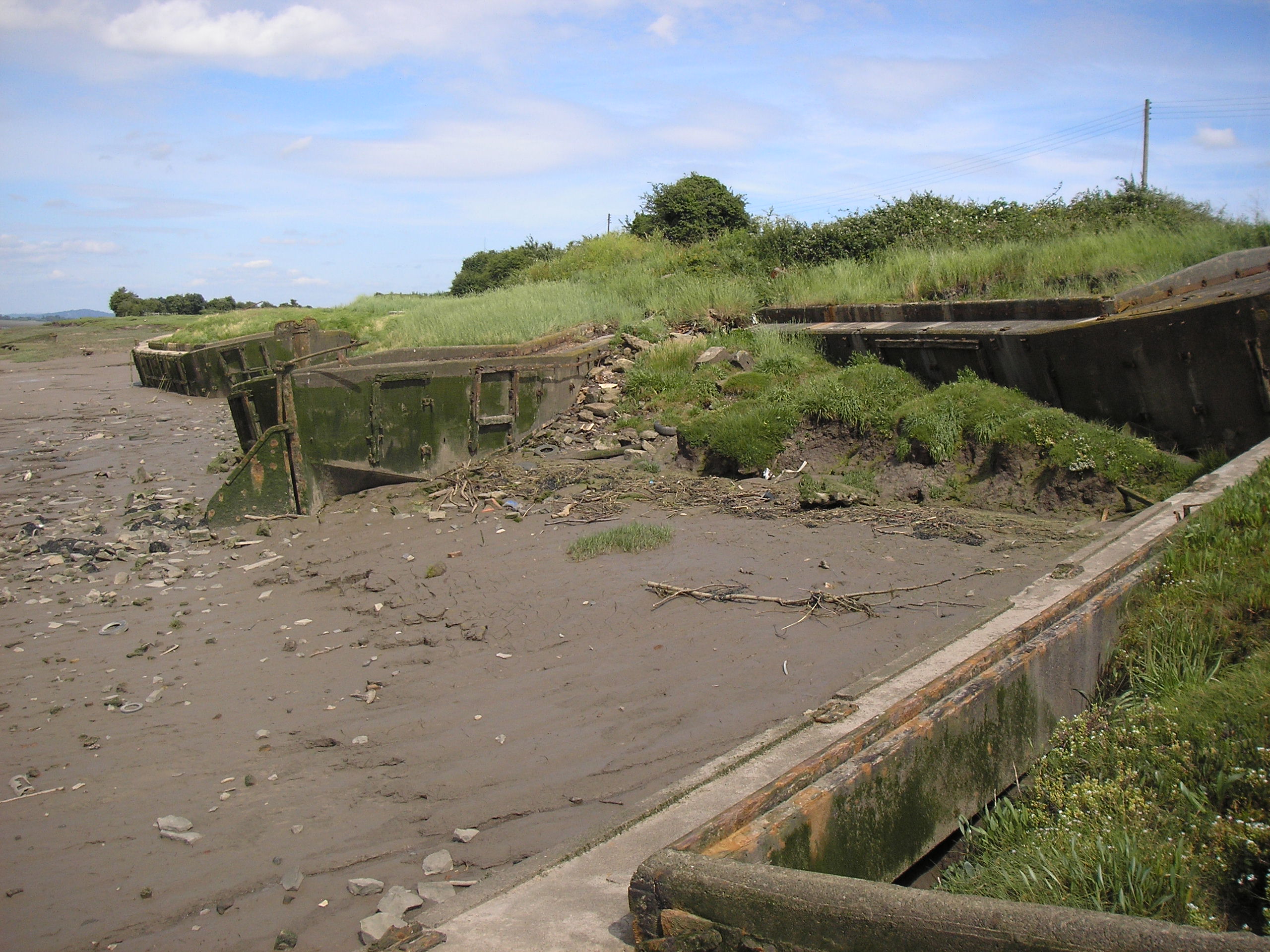
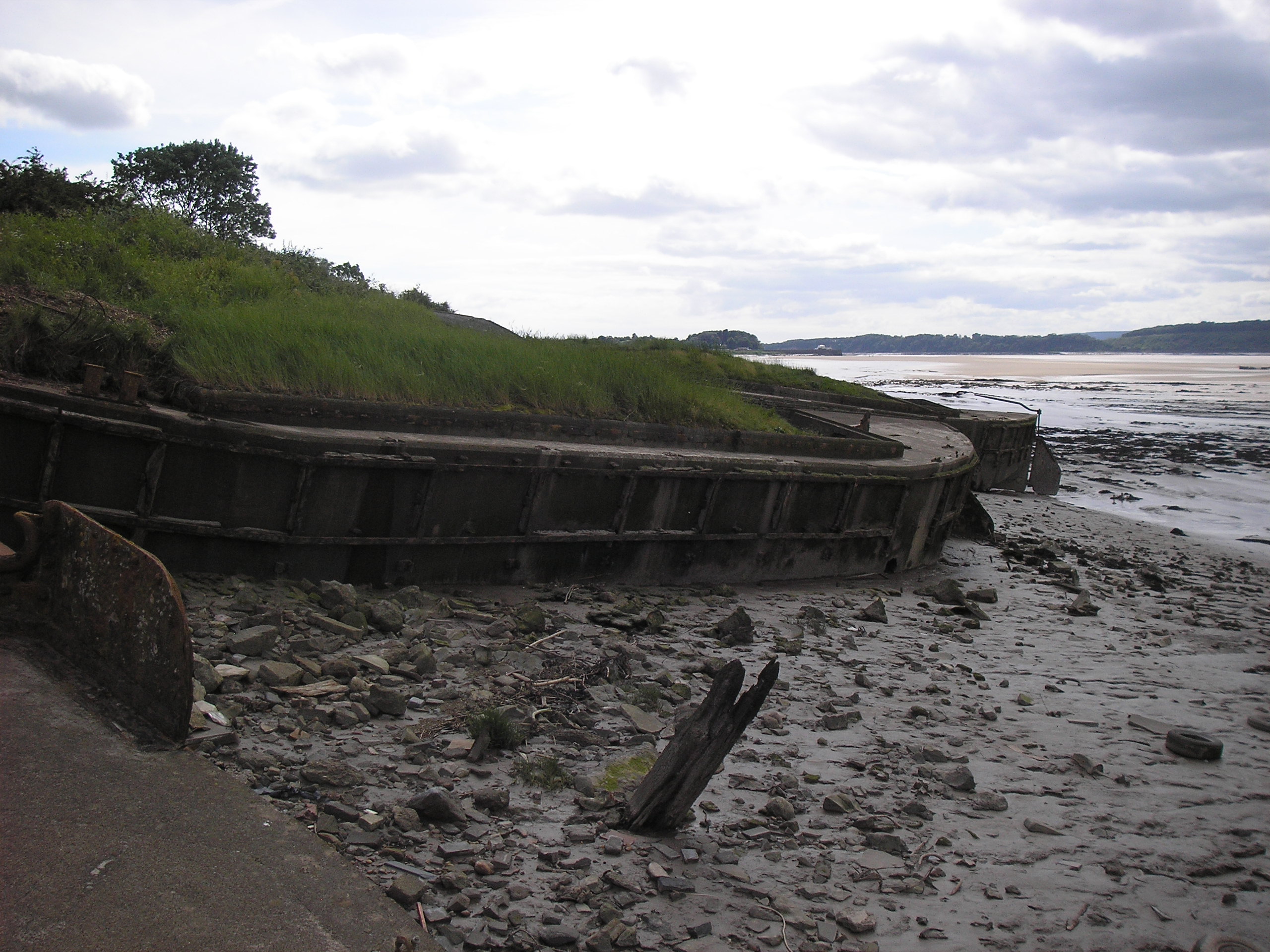
Below are some pictures of other vessels that once sailed up and down the River Severn and along the Sharpness Canal, but now rest along its' shoreline. I took these in July 2007.
 |
 |
This was a stone built chimney used to exhaust gases from a mine using a hot up draught method from an underground ventilating furnace. Examples of this that are still visible include the Findall Iron Mine chimney near Soudley and at Dodsmore Colliery, in Bream.
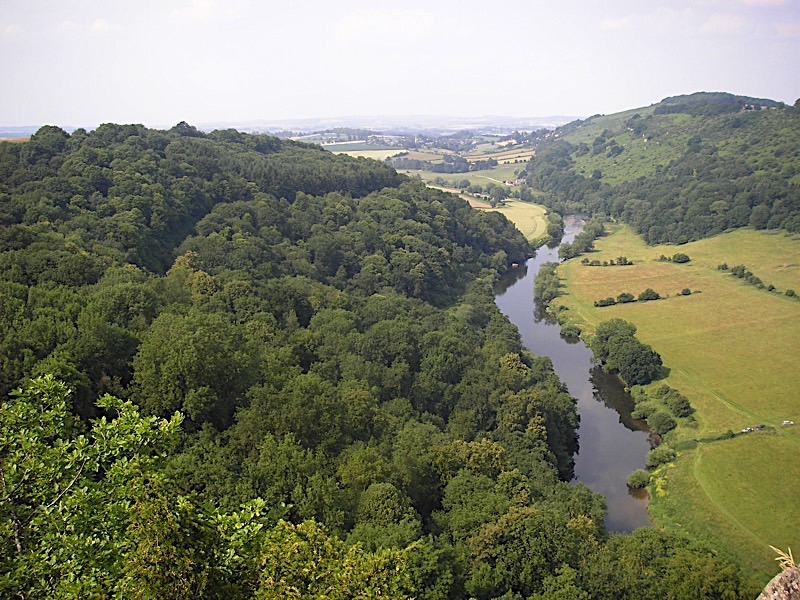 Yat is an old English word for a gateway, pass or gorge. The word is recorded as early as 1265.
Symonds Yat, on the border between Gloucestershire and Herefordshire, is the most famous example. In this particular case the word Symonds was added in the seventeenth century after Robert Symonds, who was High Sherrif of Herefordshire in 1685, whose family owned land close to Symonds Yat.
The picture, taken from a view point, looks down on the large oxbow as the River Wye winds its way southward to Chepstow.