Places and People Forest of Dean
- About the Forest of Dean
- Abenhall, Gloucestershire
- Anchor Inn, Lydbrook
- Ariconium, Herefordshire
- Arthur and Edward Colliery
- Bigsweir, Gloucestershire
- Bishopswood, Herefordshireshire
- Bixslade (Bicslade)
- Blakeney, Gloucestershire
- Bloomery (definition)
- Bradley House
- Bream, Gloucestershire
- Bullo Pill, Gloucestershire
- Cannop Colliery
- Cinderford, Gloucestershire
- Clearwell, Gloucestershire
- Coleford, Gloucestershire
- Collieries
- Crawshay, Henry
- Danby Lodge
- Darkhill Brick, Colliery + Ironworks
- Dates in the Forest of Dean
- Dean Forest (Mines) Act 1838
- Dean Forest Railway
- Dean Forest (Reafforestation)
Act 1668 - The Dean Forest Riots
- Dean Hall, Littledean
- Dean Heritage Centre
- Dean Road
- Drybrook, Gloucestershire
- Eastern United Colliery
- Fairplay Iron Mine
- Findall Iron Mine
- Flaxley, Gloucestershire
- Forest of Dean Central Railway
- Free Miners
- Green Bottom
- Gunns Mill
- The Haie (house + tunnel)
- Harvey, F. W.
- Hopewell Engine Colliery
- Horlick, James and William
- Kings Lodge
- Lightmoor Colliery
- Littledean, Gloucestershire
- Lower Redbrook, Gloucestershire
- Lydbrook, Gloucestershire
- Lydney, Gloucestershire
- Mining and Forest Terms
- Mitcheldean, Gloucestershire
- Mushet, David and Robert
- Nelson Colliery
- Newland, Gloucestershire
- Newnham, Gloucestershire
- Northern United Colliery
- Offas Dyke
- Parkend, Gloucestershire
- Pillowell, Gloucestershire
- Protheroe, Edward
- Pubs of the Forest of Dean
- Purton, Gloucestershire
- Redbrook, Gloucestershire
- Ruardean, Gloucestershire
- Severn and Wye Railway Co.
- Severn Bridge Railway
- Shakemantle Iron Mine
- Speech House
- Speech House Hill Colliery
- St Briavels Castle
- St Briavels, May-pole
- Strip-and at-it Colliery
- Symonds Yat
- Teague, James
- Teague, Moses
- Trafalgar Colliery
- Tramroad
- True Blue Colliery
- Union Colliery
- Upper and Middle Forge
- Upper Lydbrook Station
- Upper Mill, Edge Hills
- Upper Redbrook
- Verderer (definition)
- Verderers' Court
- Welshbury Hill Fort
- Westbury Brook Iron Mine
- Whitecliff Furnace
- Whitecliff House
- Whitecliff Quarry
- Whitecroft
- Whitecross Manor
- Wigpool, Gloucestershire
- Wintour, Sir John
Eastern United Colliery
Eastern United Colliery, was a drift mine with an adit an entrance which was nearly horizontal, giving it many advantages. The first gale was granted to Mr J.R. Brown in 1906, but then sold it in December 1907 to Henry Crawshay. The colliery was described as a "deep gale" extracting 'steam coal" exploiting the Coleford High Delf Seam, which was about 4 1/2 feet in thickness.
Henry Crayshay and Company purchased the colliery. Construction of railway sidings and a connection to the Great Western Railway (Forest of Dean, Bullo Branch) began in 1908. Yields were disappointing low in the early years for geological reasons but, by 1916, the output began to increase and by 1919 the output was about 250 tons each day. During this time, from 1914 the company had continued to invest, replacing boilers, pumping equipment and more modern electrics. They also increased the number of and capacity of its rail stock. However the colliery continued to run at a loss until 1923.
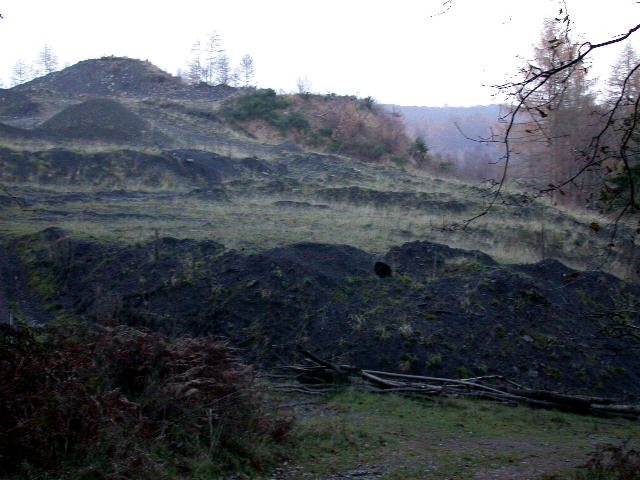
The colliery was nationalised in 1947 and became part of the South Western Division of the National Coal Board. It was finally closed on 30th January 1959. The first picture below shows the spoil, which was dragged up using a 'haulage' to this point above the Ruspidge/Soudley valley. This scar is not particularly pretty, but it is a marker to the history of Rusbridge and Soudley, providing resouce and jobs in the local area. Locals still believe there could be up to 800 tons of coal buried within or under the spoil heap. It continues to be prone to erosion. (cc-by-sa/2.0 - © Eric Soons - geograph.org.uk/p/1030238). Click on the second picture of the Pit Head Baths at Eastern United for more information.