Places and People Forest of Dean
- About the Forest of Dean
- Abenhall, Gloucestershire
- Anchor Inn, Lydbrook
- Ariconium, Herefordshire
- Arthur and Edward Colliery
- Bigsweir, Gloucestershire
- Bishopswood, Herefordshireshire
- Bixslade (Bicslade)
- Blakeney, Gloucestershire
- Bloomery (definition)
- Bradley House
- Bream, Gloucestershire
- Bullo Pill, Gloucestershire
- Cannop Colliery
- Cinderford, Gloucestershire
- Clearwell, Gloucestershire
- Coleford, Gloucestershire
- Collieries
- Crawshay, Henry
- Danby Lodge
- Darkhill Brick, Colliery + Ironworks
- Dates in the Forest of Dean
- Dean Forest (Mines) Act 1838
- Dean Forest Railway
- Dean Forest (Reafforestation)
Act 1668 - The Dean Forest Riots
- Dean Hall, Littledean
- Dean Heritage Centre
- Dean Road
- Drybrook, Gloucestershire
- Eastern United Colliery
- Fairplay Iron Mine
- Findall Iron Mine
- Flaxley, Gloucestershire
- Forest of Dean Central Railway
- Free Miners
- Green Bottom
- Gunns Mill
- The Haie (house + tunnel)
- Harvey, F. W.
- Hopewell Engine Colliery
- Horlick, James and William
- Kings Lodge
- Lightmoor Colliery
- Littledean, Gloucestershire
- Lower Redbrook, Gloucestershire
- Lydbrook, Gloucestershire
- Lydney, Gloucestershire
- Mining and Forest Terms
- Mitcheldean, Gloucestershire
- Mushet, David and Robert
- Nelson Colliery
- Newland, Gloucestershire
- Newnham, Gloucestershire
- Northern United Colliery
- Offas Dyke
- Parkend, Gloucestershire
- Pillowell, Gloucestershire
- Protheroe, Edward
- Pubs of the Forest of Dean
- Purton, Gloucestershire
- Redbrook, Gloucestershire
- Ruardean, Gloucestershire
- Severn and Wye Railway Co.
- Severn Bridge Railway
- Shakemantle Iron Mine
- Speech House
- Speech House Hill Colliery
- St Briavels Castle
- St Briavels, May-pole
- Strip-and at-it Colliery
- Symonds Yat
- Teague, James
- Teague, Moses
- Trafalgar Colliery
- Tramroad
- True Blue Colliery
- Union Colliery
- Upper and Middle Forge
- Upper Lydbrook Station
- Upper Mill, Edge Hills
- Upper Redbrook
- Verderer (definition)
- Verderers' Court
- Welshbury Hill Fort
- Westbury Brook Iron Mine
- Whitecliff Furnace
- Whitecliff House
- Whitecliff Quarry
- Whitecroft
- Whitecross Manor
- Wigpool, Gloucestershire
- Wintour, Sir John
St Briavels Castle
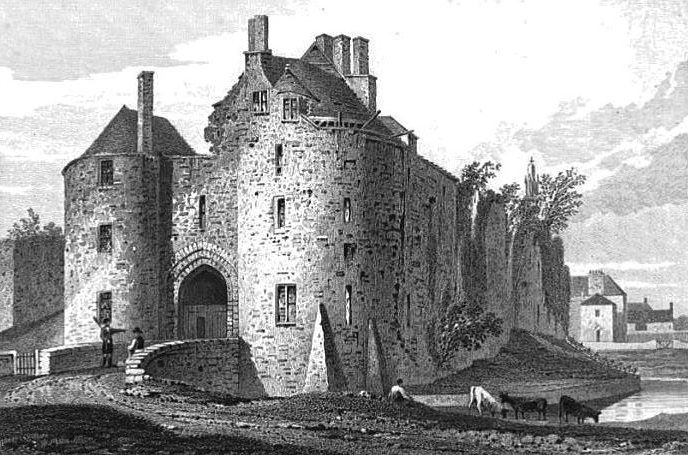 St Briavels Castle is a moated Norman Castle was built some time between 1075 and 1129 as a Royal centre of administration by the Sheriff of Gloucester, Walter of Gloucester, and his son Miles, who became Earl of Hereford in 1141. As a castle it was clearly built to be defended, but there is speculation that it was not to repel the Welsh, but to defend the Severn Estuary just to the south or from rebellious citizens.
The castle was built above the River Wye in the south-west edge of the Forest of Dean. In the first quarter of the 1200's it was a favourite hunting lodge of King John (he died of dysentery in 1216). He was succeeded by his Henry III.
Shortly after the death of King John, the Charter of the Forest was introduced. Courts were held at the Castle, punishing local peasants for cutting timber for the fires and their houses, and for hunting the local wild-life. Fines and sometimes prison were imposed.
 It was later used as an industrial armoury for the manufacture of quarrels, the arrows that were fired from crossbows, a crucial medieval weapon. The crossbow themselves were made at the Tower of London. A forge was built within the Castle in 1228. In 1233, during a four month period 120,000 quarrels were made. King Henry III garrisoned troops at the Castle in 1233/4, to defend it from the 3rd Earl of Pembroke, and others, who held interests in Normandy, Ireland and Wales. In the event the Earl attacked Monmouth Castle, fleeing to Ireland where he later died following another confrontation there.
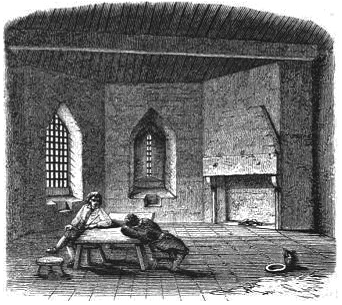
The castle has been altered numerous times during its' long history. During the 1300's and 1400's various royal favourites living there, but as it declined in importance, it was somewhat neglected. It was used as a court and as a debtor's prison. Eventually the notoriety and conditions in the prison (picture left) led to it being closed.
The castle had been built to a motte and bailey design, but the keep collapsed in the 1700's and was demolished. The stone curtain wall survived, together with a hall, a 14th century chapel and other buildings.
These were restored in the 1800's. The most impressive part of the castle is the gatehouse. It is a large and powerful structure built for defence. Following a partial collapse the south-east section was rebuilt. In 1906 St Briavels Castle was renovated and, eventually in 1948, became a Youth Hostel. It continues in that capacity to this day, owned by Englsh Heritage. The moat was filled in 1961 and made into a garden.