Places and People Forest of Dean
- About the Forest of Dean
- Abenhall, Gloucestershire
- Anchor Inn, Lydbrook
- Ariconium, Herefordshire
- Arthur and Edward Colliery
- Bigsweir, Gloucestershire
- Bishopswood, Herefordshireshire
- Bixslade (Bicslade)
- Blakeney, Gloucestershire
- Bloomery (definition)
- Bradley House
- Bream, Gloucestershire
- Bullo Pill, Gloucestershire
- Cannop Colliery
- Cinderford, Gloucestershire
- Clearwell, Gloucestershire
- Coleford, Gloucestershire
- Collieries
- Crawshay, Henry
- Danby Lodge
- Darkhill Brick, Colliery + Ironworks
- Dates in the Forest of Dean
- Dean Forest (Mines) Act 1838
- Dean Forest Railway
- Dean Forest (Reafforestation)
Act 1668 - The Dean Forest Riots
- Dean Hall, Littledean
- Dean Heritage Centre
- Dean Road
- Drybrook, Gloucestershire
- Eastern United Colliery
- Fairplay Iron Mine
- Findall Iron Mine
- Flaxley, Gloucestershire
- Forest of Dean Central Railway
- Free Miners
- Green Bottom
- Gunns Mill
- The Haie (house + tunnel)
- Harvey, F. W.
- Hopewell Engine Colliery
- Horlick, James and William
- Kings Lodge
- Lightmoor Colliery
- Littledean, Gloucestershire
- Lower Redbrook, Gloucestershire
- Lydbrook, Gloucestershire
- Lydney, Gloucestershire
- Mining and Forest Terms
- Mitcheldean, Gloucestershire
- Mushet, David and Robert
- Nelson Colliery
- Newland, Gloucestershire
- Newnham, Gloucestershire
- Northern United Colliery
- Offas Dyke
- Parkend, Gloucestershire
- Pillowell, Gloucestershire
- Protheroe, Edward
- Pubs of the Forest of Dean
- Purton, Gloucestershire
- Redbrook, Gloucestershire
- Ruardean, Gloucestershire
- Severn and Wye Railway Co.
- Severn Bridge Railway
- Shakemantle Iron Mine
- Speech House
- Speech House Hill Colliery
- St Briavels Castle
- St Briavels, May-pole
- Strip-and at-it Colliery
- Symonds Yat
- Teague, James
- Teague, Moses
- Trafalgar Colliery
- Tramroad
- True Blue Colliery
- Union Colliery
- Upper and Middle Forge
- Upper Lydbrook Station
- Upper Mill, Edge Hills
- Upper Redbrook
- Verderer (definition)
- Verderers' Court
- Welshbury Hill Fort
- Westbury Brook Iron Mine
- Whitecliff Furnace
- Whitecliff House
- Whitecliff Quarry
- Whitecroft
- Whitecross Manor
- Wigpool, Gloucestershire
- Wintour, Sir John
Dean Forest (Mines) Act 1838
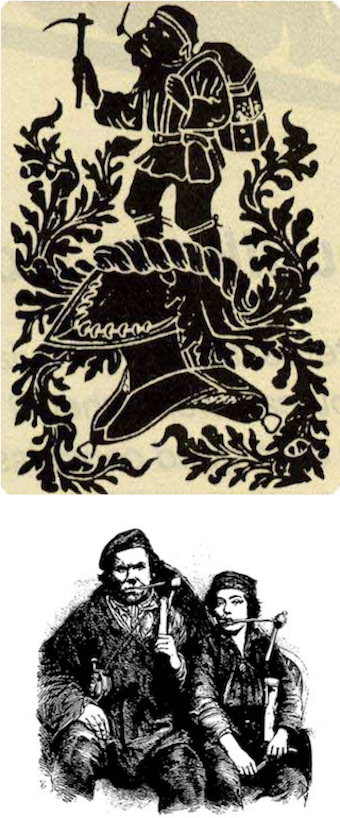
The Dean Forest (Mines) Act 1838 does not sound very interesting. However it was important for putting an early ruling into actual law to bring it up to date. It stated that - "All male persons born or hereafter to be born and abiding within the said Hundred of St Briavels, of the age of twenty one years and upwards, who shall have worked a year and a day in a coal or iron mine within the said Hundred of St Briavels, shall be deemed and taken to be Free Miners." the Dean Forest (Mines) Act 1838.[5] The ancient right to mine their own Gales (mines) was given to them by King Edward 1st in the thirteenth century. Following the death of King Alexander III of Scotland, who incidently had been married to Margaret of England, sister of King Edward I. King Edward asked the Scots for military support for his war against France. The Scots decided to support the French instead and attacked Carlisle. As a result Edward marched on Berwick. In three battles Accounts put the number killed between 4,000 and 17,000! The sieges of Berwick would not have been successful if it had not been the Forest miners who undermined the defences on several occasions. Thus, he bestowed the ancient right of Freeminers to the Forest miners in the 13th century. The Dean Forest (Mines) Act 1838 stated that to be a Freeminer the following must apply :- "All male persons born or hereafter to be born and abiding within the said ‘Hundred of St Briavels’, of the age of twenty-one years and upwards, who shall have worked a year and a day in a coal or iron mine shall be deemed and taken to be Free Miners.” The ancient area, known then as the ‘Hundred of St Briavels’, is generally considered to be the whole of the Forest of Dean and each parish adjoining it. The Forestry Commissioners decided to allow females on to the register in 2010! Working as a Freeminer was very hard work and meant long hours working in very small places, in cramped condtions, sometimes deep underground. It would be dark and probably wet and the only light would be from their helmets. The work was back-breaking, with little space to wield a pickaxe. The coal dug from the seam would be loaded into a 'dram' (cart) and then dragged to the surface. It was dangerous being a freeminer. There could be poisonous gases (such as black damp). Long ago children were sometime sent down the mines. They might be only six or seven years old, perhaps working alongside their fathers or brothers. Imagine all that dust, the stale air, crouching and bending for maybe 12 hours each shift. Nowadays Freemining is controlled by the Deputy Gaveller. It is thought that there may be 150 Freeminers alive today, but many work elsewhere as it is difficult to make a living out of it. However Freeminers are proud people, unique in the world, and they are very proud of their history and culture. |
 |