Places and People Forest of Dean
- About the Forest of Dean
- Abenhall, Gloucestershire
- Anchor Inn, Lydbrook
- Ariconium, Herefordshire
- Arthur and Edward Colliery
- Bigsweir, Gloucestershire
- Bishopswood, Herefordshireshire
- Bixslade (Bicslade)
- Blakeney, Gloucestershire
- Bloomery (definition)
- Bradley House
- Bream, Gloucestershire
- Bullo Pill, Gloucestershire
- Cannop Colliery
- Cinderford, Gloucestershire
- Clearwell, Gloucestershire
- Coleford, Gloucestershire
- Collieries
- Crawshay, Henry
- Danby Lodge
- Darkhill Brick, Colliery + Ironworks
- Dates in the Forest of Dean
- Dean Forest (Mines) Act 1838
- Dean Forest Railway
- Dean Forest (Reafforestation)
Act 1668 - The Dean Forest Riots
- Dean Hall, Littledean
- Dean Heritage Centre
- Dean Road
- Drybrook, Gloucestershire
- Eastern United Colliery
- Fairplay Iron Mine
- Findall Iron Mine
- Flaxley, Gloucestershire
- Forest of Dean Central Railway
- Free Miners
- Green Bottom
- Gunns Mill
- The Haie (house + tunnel)
- Harvey, F. W.
- Hopewell Engine Colliery
- Horlick, James and William
- Kings Lodge
- Lightmoor Colliery
- Littledean, Gloucestershire
- Lower Redbrook, Gloucestershire
- Lydbrook, Gloucestershire
- Lydney, Gloucestershire
- Mining and Forest Terms
- Mitcheldean, Gloucestershire
- Mushet, David and Robert
- Nelson Colliery
- Newland, Gloucestershire
- Newnham, Gloucestershire
- Northern United Colliery
- Offas Dyke
- Parkend, Gloucestershire
- Pillowell, Gloucestershire
- Protheroe, Edward
- Pubs of the Forest of Dean
- Purton, Gloucestershire
- Redbrook, Gloucestershire
- Ruardean, Gloucestershire
- Severn and Wye Railway Co.
- Severn Bridge Railway
- Shakemantle Iron Mine
- Speech House
- Speech House Hill Colliery
- St Briavels Castle
- St Briavels, May-pole
- Strip-and at-it Colliery
- Symonds Yat
- Teague, James
- Teague, Moses
- Trafalgar Colliery
- Tramroad
- True Blue Colliery
- Union Colliery
- Upper and Middle Forge
- Upper Lydbrook Station
- Upper Mill, Edge Hills
- Upper Redbrook
- Verderer (definition)
- Verderers' Court
- Welshbury Hill Fort
- Westbury Brook Iron Mine
- Whitecliff Furnace
- Whitecliff House
- Whitecliff Quarry
- Whitecroft
- Whitecross Manor
- Wigpool, Gloucestershire
- Wintour, Sir John
Ruardean, Gloucestershire
Several generations of Burgums lived at Ruardean.
RUARDEAN, a parish in the hundred of St. Briavel's, county Gloucester, 6 miles from Ross, its post town, the same distance N.W. of Newnham, and 3 from Mitcheldean Road railway station. The village, which is of small extent, is situated on a lofty ridge, overlooking the valley of the river Wye. The Severn and Wye railway passes through the parish. The inhabitants are chiefly engaged in agriculture. The surface is elevated, and is watered by a small brook, called Bishop's Brook, which separates this parish from the county of Hereford. The substratum contains limestone and coal.
The living is a vicarage in the diocese of Gloucester and Bristol, value £100, in the patronage of the bishop. The church, dedicated to St. John the Baptist, has a spired tower containing six bells. The west window is enriched with tracery. The parochial charities produce about £14 per annum. Kingsmill Manby Power, Esq., is lord of the manor. There are ruins of an ancient castle.
Description from The National Gazetteer of Great Britain and Ireland (1868)
Sadly Ruardean is famous for another reason. On 26th April 1889 four Frenchmen and their two bears had been performing and entertaining in nearby Cinderford. Inexplicably rumours had it that the two bears had killed a local child and injured a woman. Both bears were killed and the four Frenchmen were badly beaten. No such attack had taken place. A week later thirteen men appeared in court, charged with the attack. Twelve of the men were proven guilty and the total of the fines was £85, which in todays money would be about £11,200, an eye-watering amount of money!None of the men convicted were actually from Cinderford! A local shop was later called the "Bare Necessities"!
The Reverand John Horlick was the Congregational minister for Ruardean in the early 19th century. His relatives, James and William, were born in Ruardean and are famous worldwide for their hot malt drink Horlicks. They developed the technique of producing the dried milk with malt in a shed, in the 1860s. That shed still stands behind the Malt Shovel public house on the main high street. Eventually the brothers founded a company in thge USA as an artifical infant drink. The rest is, as they say, is history.
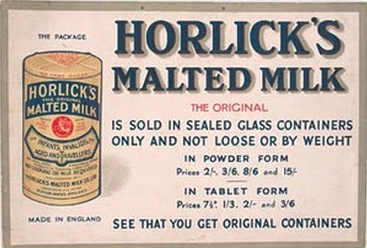
For more on the Horlicks family Click here.