Places and People Forest of Dean
- About the Forest of Dean
- Abenhall, Gloucestershire
- Anchor Inn, Lydbrook
- Ariconium, Herefordshire
- Arthur and Edward Colliery
- Bigsweir, Gloucestershire
- Bishopswood, Herefordshireshire
- Bixslade (Bicslade)
- Blakeney, Gloucestershire
- Bloomery (definition)
- Bradley House
- Bream, Gloucestershire
- Bullo Pill, Gloucestershire
- Cannop Colliery
- Cinderford, Gloucestershire
- Clearwell, Gloucestershire
- Coleford, Gloucestershire
- Collieries
- Crawshay, Henry
- Danby Lodge
- Darkhill Brick, Colliery + Ironworks
- Dates in the Forest of Dean
- Dean Forest (Mines) Act 1838
- Dean Forest Railway
- Dean Forest (Reafforestation)
Act 1668 - The Dean Forest Riots
- Dean Hall, Littledean
- Dean Heritage Centre
- Dean Road
- Drybrook, Gloucestershire
- Eastern United Colliery
- Fairplay Iron Mine
- Findall Iron Mine
- Flaxley, Gloucestershire
- Forest of Dean Central Railway
- Free Miners
- Green Bottom
- Gunns Mill
- The Haie (house + tunnel)
- Harvey, F. W.
- Hopewell Engine Colliery
- Horlick, James and William
- Kings Lodge
- Lightmoor Colliery
- Littledean, Gloucestershire
- Lower Redbrook, Gloucestershire
- Lydbrook, Gloucestershire
- Lydney, Gloucestershire
- Mining and Forest Terms
- Mitcheldean, Gloucestershire
- Mushet, David and Robert
- Nelson Colliery
- Newland, Gloucestershire
- Newnham, Gloucestershire
- Northern United Colliery
- Offas Dyke
- Parkend, Gloucestershire
- Pillowell, Gloucestershire
- Protheroe, Edward
- Pubs of the Forest of Dean
- Purton, Gloucestershire
- Redbrook, Gloucestershire
- Ruardean, Gloucestershire
- Severn and Wye Railway Co.
- Severn Bridge Railway
- Shakemantle Iron Mine
- Speech House
- Speech House Hill Colliery
- St Briavels Castle
- St Briavels, May-pole
- Strip-and at-it Colliery
- Symonds Yat
- Teague, James
- Teague, Moses
- Trafalgar Colliery
- Tramroad
- True Blue Colliery
- Union Colliery
- Upper and Middle Forge
- Upper Lydbrook Station
- Upper Mill, Edge Hills
- Upper Redbrook
- Verderer (definition)
- Verderers' Court
- Welshbury Hill Fort
- Westbury Brook Iron Mine
- Whitecliff Furnace
- Whitecliff House
- Whitecliff Quarry
- Whitecroft
- Whitecross Manor
- Wigpool, Gloucestershire
- Wintour, Sir John
Forest of Dean Central Railway
| The Forest of Dean Central Railway was an ill-judged disaster. The idea was to connect a number of collieries in the central part of of the Forest of Dean and transport coal to Brimspill on the banks of the River Severn. It was planned to go from Foxes Bridge, passed New Fancy Colliery, Brandrick's Green and Howbeach Colliery and then continue through Blakeney to Brimspill. The first plan surfaced in 1830 and presented to Parliament in 1832. Despite some construction taking place the line was never finished. Further proposals were made in 1840 (Edward Protheroe), in 1849 and 1850. All failed. A bill was put to Parliament and received oyal Assent in July 1856. The route was to be the one described above. Over several years plans were made, estimates obtained and shareholders made promises of investment. Construction commenced and much of the line was built. However it still did not reach Brimspill. In June 1862 E.W. Morris, the contractor, stopped working. He had not been paid! Despite legal action by 1865 Morris was owed £40,000. Meanwhile some of the construction work was critisised by an engineer, the company had failed to pay rents for the land and had not enclosed the railway with fencing as agreed. The situation was hopeless, but Great Western Railway agreed to step in and operate the line and they also paid Morris to complete his work. An expert on railways in the Forest of Dean, H.W. Paar stated - "The company appears to have ruined Morris for, ten years later, he was reduced to a pathetic state of poverty, with little hope of ever recovering what was due to him." In June 1867 the line was still not completely ready and the County Sheriff issued a writ and seized the line. Two men were posted to prevent the line being used. Finally in May 1868 the GWR were given permission to operate the line to goods traffic. However the section from New Fancy Junction to Foxes Bridge was never completed. At the other end of the line, the short section to Brimspill was also never completed! The railway to nowhere! To make matters worse Parliament granted an Act to the Severn and Wye Railway despite the protests of the troubled Forest of Dean Central Railway. The S&WR called it the mineral loop and and that was opened in July 1872.
|
|
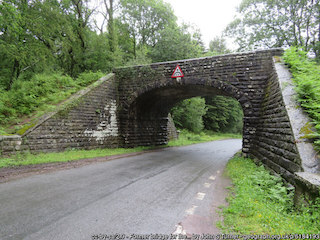
Things went from bad to worse when, as expected, the S&WR took away most of the transportation business at New Fancy. It seems that little or no traffic operated on the Central line and operations beyond Howbeach ceased in 1877. Occasional mineral traffic continued, operated by GWR. In 1923, following the Railways Act of 1921, the GWR simply absorbed the Forest of Dean Central Railway. No orginal shareholders could be found and so GWR received it for free! The line became busy during the Second World War, mostly carrying charcoal. Things got quiter after the War and the last train ran on Frriday 29th July 1949. The railway tracks were removed in 1962, but the route is still there for all to see. The tracks passed over a substantial stone bridge at Blackpool Bridge, passing over the Roman Road (picture right). This was only a mile from where I lived and was a constant reminder of the wonderful industrial history of the Forest. It was also a reminder of how not to run a railway! |
|