Journal Articles
- A day in the Life of a Charcoal-burner
- Alan Tubman - "QQ" Family Tree
- The Alternative Burghams
- Anthony Thomas Burgum (1834-1913)
- Around the World in 44 days!
- Attempted Murder!
- Biddy Burgum; War memories and Playing for England
- Biographical Memories, by June Dryden
- Bob Bartley (1937-2003)
- The Brazilian Connection
- Brazilian Family
- Burgum 2000
- The Burgums and the Burghams (& Brougham)
- Burgum's Cove
- The Cawnpore Massacre, India 1857
- Charlotte Burgum and Fredrick Weight - the Mormon Connection
- Colour Sgt, George T.C. Burgum (1825-1859)
- Concord Visit/Mark's Tragedy
- Daughters in the Workhouse
- Edwin Berry Burgum (1894-1979)
- Ellis Island
- The Fleet Prison
- The Gannells
- Henry Burgum, Pewterer (1739-1789)
- Henry & the Warrior
- Incredible, But True! (Linda Slaughter)
- James Burgum, In Court following a Suicide (1825-1892)
- John Burgum, Ornamental Painter (1826-1907)
- John Burgum - Referee For All Seasons
- Josiah Burgum and the King's African Rifles
- Letter From The Past
- A Magnificent Adventure!
- The Maleny Burgums
- Memories, by Alice Farnham Lillie
- My Father and Alzheimers
- New York, New York/Grace Darling
- The Redknap Family
- The Redbrook Burghams
- Richard Burgum - Convict!
- Sergeant Riggs VC
- Siddy Burgum; his Astonishing Story
- Sir Benjamin Thompson, Count Rumford, (1753-1814)
- Sunk!
- Thomas Ebenezer Burgum (1886-1975)
- A Visit to Frank & Edna Burgum
- William Arnold Burgum, Bomber Pilot (1921-1942)
The Gannells
Emma Gannell provided the fascinating link between the Rumfords and the Burgum family. Here is more of the story about the Gannell family.
| Henry Gannell, a silversmith, met Mary Ann Grove in the first half of the nineteenth century. Mary was a maid, working for Sarah Thompson, the Countess Rumford. Henry and Mary were married in 1824. On April 30th 1826, their first child Emma was born. Emma was adopted by the Countess and lived the first nineteen years of her life in London (45 Brompton Row), in Paris and in Concord, New Hampshire, USA. A Henry Gannell was christened at Ebenezer Chapel, Market Street, Mayfair, Westminster on July 18th 1805. The parents were listed as William and Martha Gannell. (A brother George had been christened at the same chapel in 1804). Was this the Henry Gannell who married Mary Grove in 1824? Henry and Mary Gannell had three more children. Edwin was born on September 8th 1830. The third and fourth children were Isabella Frances Gannell, christened on December 21st 1833, and Henry Gannell, christened November 20th 1835. Both christenings took place at St John the Baptist Church, Croydon, in Surrey. Henry later became a wine merchant. In 1851 Emma received the following letter from her brother, Edwin... Belgrave Road, London My dear Sister, I received your kind letter Sept 30th. I soon after rec (sic) one from Mrs Abbott. I am very busy working day and night almost for Messers Simpson the Government Engineers. I am doing very well indeed earning on average about 35 shillings per week. Be kind enough to give me your opinion respecting my return to A merica. We have just removed to the next house which is private, very pretty and very reasonable. We are all in excellent Health. You must excuse the shortness of my letter as I am just starting for London having paid Mother a short visit. We all send our love hoping tou are in good health and our dear friend the Countess. I should be exceedingly happy to see you both in the Spring. I am, my dear sister, your affectionate Brother, Edwin Gannell. Direst. 83 Thornton Heath, Croydon, Surrey, England Edwin refers in his letter to his possible "return to America". His first visit took place when he was just seventeen. He sailed steerage to New York on board the "Hendrick Hudson" on 28th April 1848, at a cost of £6.00. The booked date of travel was, of course, subject to "wind and weather permitting". Steerage passengers were also required to provide all provisions, cooking utensils and bedding. The ship only provided fuel and water.Travelling steerage across the Atlantic in the nineteenth century was very much an ordeal. The carriage of emigrants was big business. At the time in question, Liverpool had 200,000 emigrants a year passing through other European ports. Passage across the Atlantic on a sailing ship took about six weeks. At the port, travellers ran the gauntlet of thieves, tricksters and prostitutes. The conditions on board were usually cramped and generally badly ventilated. Hygiene was generally poor and sea-sickness common. Drinking water was rationed and sometimes tainted. Inthese often wretched conditions, emigrants slept in unsegregated pine berths placed side by side. Disease, molestation and robbery were even more real to the passengers than shipwreck and fire. 1847 and 1853 were the worst years for passenger mortality with typhus and cholera the greatest killers. (In 1847 alone, 17,000 emigrants died of typhus either on board ship or while in quarantine in America). Improvements in conditions across the Atlantic came slowly. Even after the introduction of steamships, which reduced the crossing time from six weeks to two weeks, passage remained squalid. Perhaps it is fair to say that conditions had become more tolerable, rather than comfortable, by the beginning of the twentieth century. In 1907, an amazing one and a quarter million emigrants crossed the Atlantic into the USA. Edwin clearly survived his journey to the USA in 1848. Another Certificate of Passage indicates that Edwin returned to England a year later, on 5th March 1849. The crossing was booked, again in steerage, on board the ship "Plymouth Rock" from Boston to Liverpool. We actually know something about Edwin's appearance. In December 1851, Edwin obtained his Mariner's Ticket. It states that Edwin was five foot five inches tall, had brown hair, fair complexion and blue eyes. He worked his passage on board the "Bernisia", obtaining a discharge at Geelong (near Melbourne) in Australia. After a short stay, Edwin paid for his passage back to Liverpool. |
 |
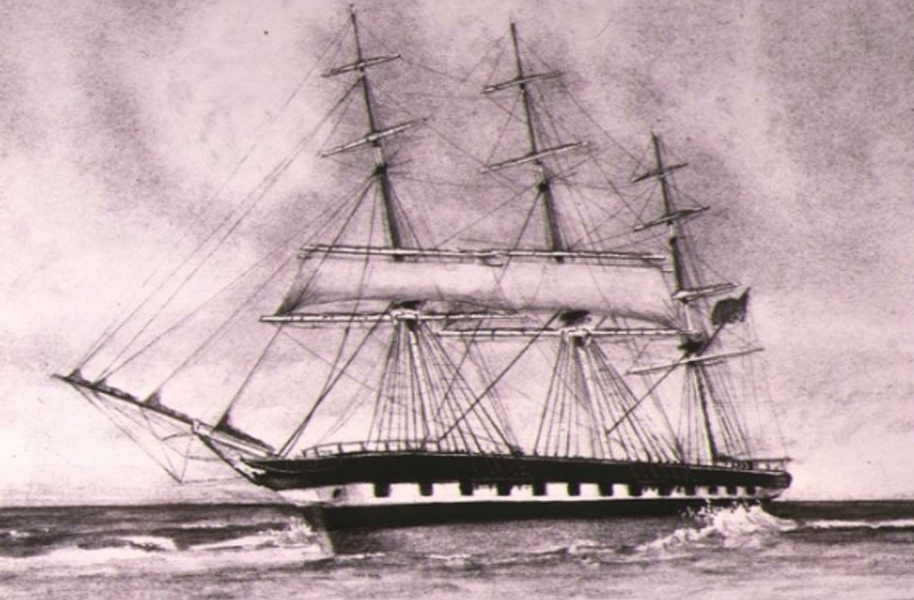
On 9th August 1856, Edwin Gannell married Charlotte Ann Toby at St Luke's Church, Chelsea. (Picture left) Eight weeks later, Edwin and Charlotte sailed to Melbourne, Australia, on board the "Sussex" (picture right). They travelled second-class and arrived in Melbourne on 14th January 1857. Such trips were hazardous. The Sussex, a London built Blackwall frigate was on its 28th visit to Australia and, after a voyage of 82 days, arrived on 31 December 1871. However it ran aground and, although most were rescued, cargo and personal possessions were completely lost! |
 |
|
Edwin and Charlotte Gannell had six children and, from 1862, Edwin became the Postmaster at Reid's Creek. Edwin's mother, Mary Ann Gannell, once maid to the Countess Rumford, died on January 14th 1872 at Sydney St, Chelsea, in England. She was 67. |
Dear Cousin Charlotte,
I know it is a long while since I last wrote you and have been remiss in thanking you for the interesting papers you send. I am sorry to say that Edwin's memory is in sad condition. He has been unable to paint for two years and cannot concentrate on anything. He is 87 and Charlie who is 89 has failed sadly since he no longer is able to do anything and feels it keenly. His mind is normal but eyesight poor and is now very deaf.
I hope you are in better condition and still able to enjoy life as it is. We were sorry to learn of Ted's untimely death every paper is full of them. So many escaped death in service and have met death soon after reaching home. It is very sad and lately I have read that this most horrible was not necessary. Why was it if not for greed? I suppose you are now enjoying springtime and our winter just beginning and in earnest as it is very cold. 10 degrees (f.) this morning but no snow yet.
We are now allowed more fuel oil and can be warm and food is more plentiful, but sugar is still scarce, nothing else is rationed. We in our sheltered home have much to be thankful for and little realise the awful suffering abroad. I hope some day the World will know real peace that our boys have not died in vain, but it will not come for many years. God has been forgotten too long. We must have more faith in him. Remember me to your niece, she too has sent papers.
Love from Cousin Minnie