Journal Articles
- A day in the Life of a Charcoal-burner
- Alan Tubman - "QQ" Family Tree
- The Alternative Burghams
- Anthony Thomas Burgum (1834-1913)
- Around the World in 44 days!
- Attempted Murder!
- Biddy Burgum; War memories and Playing for England
- Biographical Memories, by June Dryden
- Bob Bartley (1937-2003)
- The Brazilian Connection
- Brazilian Family
- Burgum 2000
- The Burgums and the Burghams (& Brougham)
- Burgum's Cove
- The Cawnpore Massacre, India 1857
- Charlotte Burgum and Fredrick Weight - the Mormon Connection
- Colour Sgt, George T.C. Burgum (1825-1859)
- Concord Visit/Mark's Tragedy
- Daughters in the Workhouse
- Edwin Berry Burgum (1894-1979)
- Ellis Island
- The Fleet Prison
- The Gannells
- Henry Burgum, Pewterer (1739-1789)
- Henry & the Warrior
- Incredible, But True! (Linda Slaughter)
- James Burgum, In Court following a Suicide (1825-1892)
- John Burgum, Ornamental Painter (1826-1907)
- John Burgum - Referee For All Seasons
- Josiah Burgum and the King's African Rifles
- Letter From The Past
- A Magnificent Adventure!
- The Maleny Burgums
- Memories, by Alice Farnham Lillie
- My Father and Alzheimers
- New York, New York/Grace Darling
- The Redknap Family
- The Redbrook Burghams
- Richard Burgum - Convict!
- Sergeant Riggs VC
- Siddy Burgum; his Astonishing Story
- Sir Benjamin Thompson, Count Rumford, (1753-1814)
- Sunk!
- Thomas Ebenezer Burgum (1886-1975)
- A Visit to Frank & Edna Burgum
- William Arnold Burgum, Bomber Pilot (1921-1942)
THE FLEET PRISON
One of our more interesting ancestors is Henry Burgum, the Bristol pewterer. He was the man who, in the 1700's, was sold a fake pedigree by Thomas Chatterton, the Bristol poet. Most of you will have read about Henry in earlier volumes of the BURGUM FAMILY HISTORY SOCIETY Journal over the years. Henry was attacked and ridiculed for being duped by the young Chatterton. His own pomposity probably made things worse. Henry had yearned to "fit-in" in Bristol society and tried hard to overcome his Forest of Dean accent and his modest beginnings. Henry ultimately neglected his businesses and retreated behind his passion of music. He left Catcott, his partner, to deal with the pewter business and over time it failed. One can imagine Henry continuing a lavish lifestyle as his income diminished. Perhaps he was deaf to the warnings or perhaps it was too late to recover the situation. Henry was declared bankrupt in 1783. By 1786, Henry had lost the use of his limbs from Gout and was lodged as an insolvent debtor in the Fleet Prison.
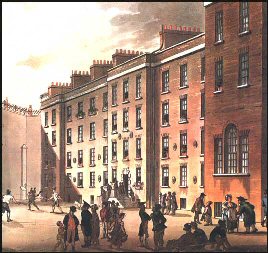
The Fleet Prison
The Fleet Prison stood on the eastern bank of the river Fleet, just outside London's city walls. It was built in 1197, but was destroyed three
times. In 1381 it was destroyed in the Peasant's Revolt, it was destroyed in the Great Fire of 1666, and again in the Gordon riots of 1780.
Each time it was rebuilt soon afterwards.
The Fleet Prison was mainly used for debtors and bankrupts and had a capacity of about 300. Prisons were profit-making enterprises and everything had to be paid for. There was a charge for food and lodging. There was a charge for putting on the chains or "irons" and another charge for taking them off.
Even visitors were charged to go in. The Fleet Prison was said to have had the highest fees in the country. The keeper of the prison was known as the warden of the Fleet, while the guards were known as "turnkeys".
Prisoners with a trade were permitted to work, while others had to resort to begging. A grille was built in the wall on the Farringdon Street side of the prison, so that prisoners could beg to the passers-by.
The buildings were four-storeys high (five floors including the cellars) and they enclosed a
courtyard called the racket-ground where the prisoners exercised and even played tennis fives.
 Poor prisoners languished in the cellar dungeons (called the "Fair"), while those who could afford it lodged in more comfortable quarters.
Some were permitted (at a price) to have their families with them.
Poor prisoners languished in the cellar dungeons (called the "Fair"), while those who could afford it lodged in more comfortable quarters.
Some were permitted (at a price) to have their families with them.
Other prisoners were even allowed to stay just outside the prison in an area known as the "Liberty of the Fleet". They would have to pay for this, of course. Beer and tobacco was available to those who could pay, but many had no money and little hope. Many died within it's high walls.
We do not know whether HenryBurgum or not had the resources to stay in the more "comfortable" quarters, but the conditions would have been pretty grim. Some were allowed to have their families with them but, invalided through gout, he would have had a miserable existance.
The Fleet Prison is decribed in "The Rake's Progress" by William Hogarth and by Charles Dickens in "The
Pickwick Papers" (chapter 41). The prison was finally demolished in 1846.